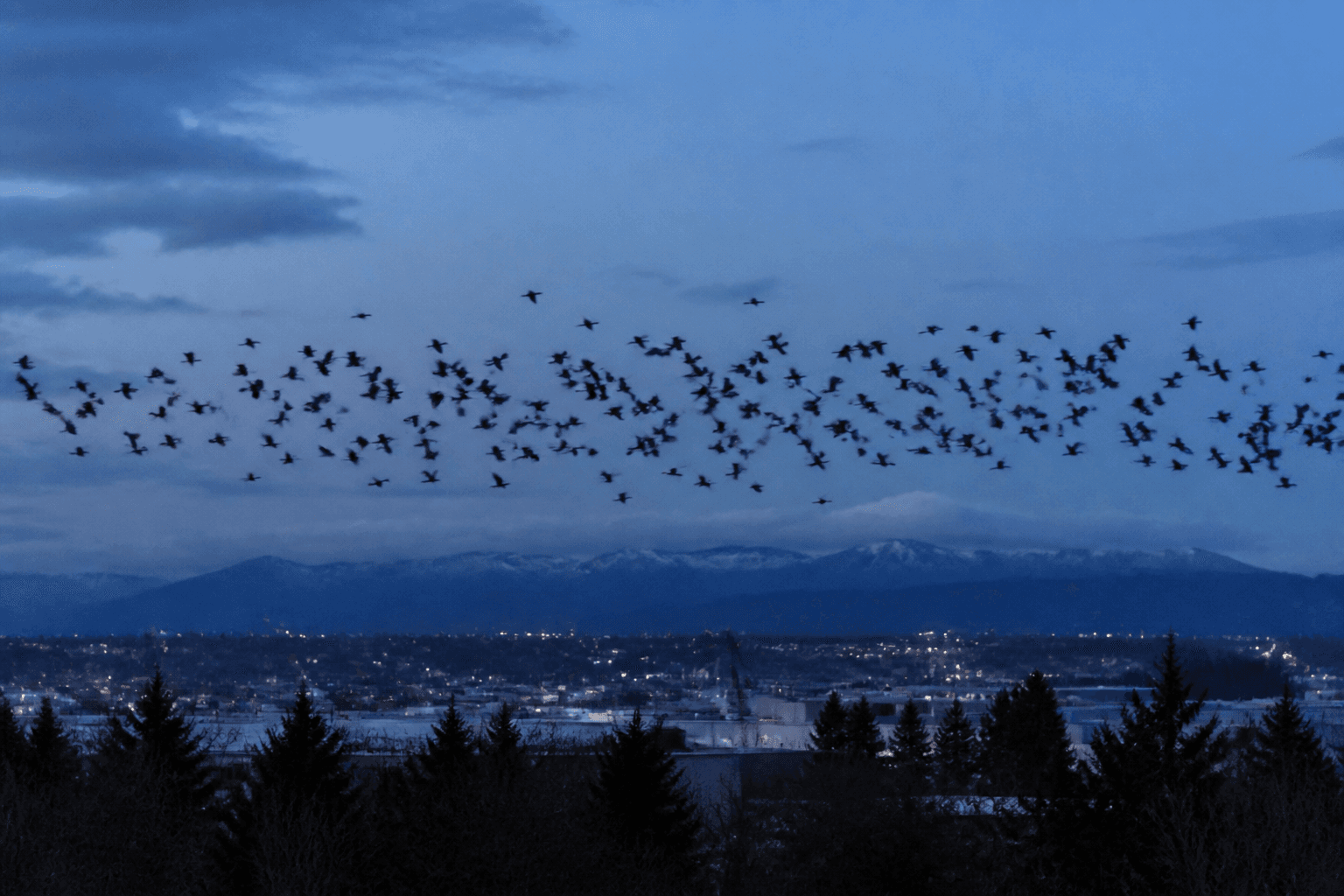

There is a point in the evening when the sky over Metro Vancouver stops looking empty and starts looking like somebody has opened a black zipper across it.
I first assumed the long strings of crows heading northeast were simply a local flock shifting between a couple of good food spots. The more entertaining answer is that they are commuters. Thousands of birds that spent the day spread across Vancouver, Burnaby, Coquitlam, Port Moody, New Westminster, Richmond, Surrey, and North Vancouver converge on one shared bedroom near Still Creek in Burnaby.
Not a poetic shared bedroom. An actual one: a huge communal roost near Willingdon Avenue and Highway 1. The most Metro Vancouver detail imaginable is that a major wildlife spectacle happens beside traffic, commercial buildings, and the kind of road I normally only think about when it is jammed.
The line that has no beginning or end
The first unnerving part is how the crows can seem to form one endless line. You look northeast and there they are: a moving thread of black dots. You look back a few minutes later and the thread is still feeding itself.
That impression makes sense because the roost receives birds from a broad surrounding area rather than one tidy, centrally assembled flock. The Still Creek study documented evening approach directions spanning much of Metro Vancouver and estimated a roughly 15–20 km collection radius. From the ground, many arriving groups and flight paths can overlap into what looks like one line with no sensible beginning or end.
The numbers are big enough to justify the drama. A scientific account of the Still Creek roost records an estimate of 10,000 crows in November. CBC has likewise reported that the roost can reach up to 10,000 birds during winter months. So if the line looks too large to count, that is not your eyes being theatrical. The sky is briefly running an avian transit system.
It is also the wrong thing to try to count from a balcony or sidewalk. A visible ribbon may be one stream among several, and birds can be leaving different neighbourhoods on slightly different schedules. What seems like a single flock might be the visible segment of a regional convergence.
Territory by day, hotel by night
The part that initially broke my mental model was this: crows are territorial, so why would they all happily pile into the same place every night?
The answer is that crow life has different modes. Cornell describes a “double life” in some populations: families maintain a home territory while individual birds still join larger feeding flocks and communal roosts during much of the year. A daytime territory is not a permanently sealed national border. It is a useful arrangement for feeding, nesting, and raising young.
That is why both observations can be true. A crow pair can be extremely opinionated about who belongs near its nest or favourite lawn, then leave that area to roost with a very large crowd after dark. The territorial argument resumes in the morning; the group sleepover does not erase it.
Still Creek has been part of this story since the 1970s, although the exact patches of trees used by the roost have shifted as development changed the area. That is a small but excellent urban-nature detail: the birds have had to adjust their accommodations while the city rebuilt the block around them.
Why they keep choosing this corridor is less settled. Local ornithologist Rob Butler told CBC that safety from nocturnal predators is probably part of the appeal. The research record describes the site as a busy, lit area around Still Creek, Highway 1, and commercial development, but it does not offer a single neat answer for why that specific place won. The crows did not read a municipal plan and select the site for its amenities. They kept choosing it, and then kept adapting.
Why other crow-heavy places do not look like this
I had assumed that any city with lots of crows should have the same eerie evening procession. Apparently, not at all.
Communal crow roosting itself is widespread. Cornell notes that American crow roosts can range from a few hundred birds to as many as two million, and some persist in the same general area for more than a century. But a communal roost is not automatically a visible crow highway. That part depends on where the roost sits, where the birds forage during the day, and whether their routes cross open places people actually notice.
Metro Vancouver gets the full show because Still Creek has a large, persistent roost and birds travel to it from many directions across the region. The study’s recorded approach directions include Vancouver, North Vancouver, north Richmond, north Surrey, New Westminster, Port Moody, and eastern Coquitlam. A city with several smaller roosts—or flight paths mostly hidden by woods and low-rise streets—could have plenty of crows without presenting the same black conveyor belt over the sky. That last part is an inference, but it fits the basic geometry: one large destination produces a more visible convergence than many small ones.
Season helps too. Cornell specifically notes large winter communal roosts, while the Burnaby research connects the roost’s size and the dispersal of birds to breeding territories across the year. So the evening stream is not necessarily equally dramatic in every month. When the density seems to change, it probably is not just the lighting playing tricks.
A city-sized animal behaviour
What I like most about the crow commute is that it makes a familiar urban animal suddenly feel enormous.
A single crow on a hydro wire is background noise. Ten thousand moving across the sky turns the whole region into one connected habitat. The crow you see in Coquitlam is not necessarily a Coquitlam crow in the simple sense. It may be part of a nightly system that stretches across municipalities people usually treat as separate places.
We build our routines around invisible networks all the time: traffic flows, transit lines, delivery routes, phone signals. The crow highway is the same kind of thing, except it runs at dusk, makes a tremendous amount of noise, and refuses to respect municipal boundaries.
The next time the line seems to go on forever, I am not going to try to find its beginning or end. That is the wrong scale for it. It is not one line. It is a whole region heading home.