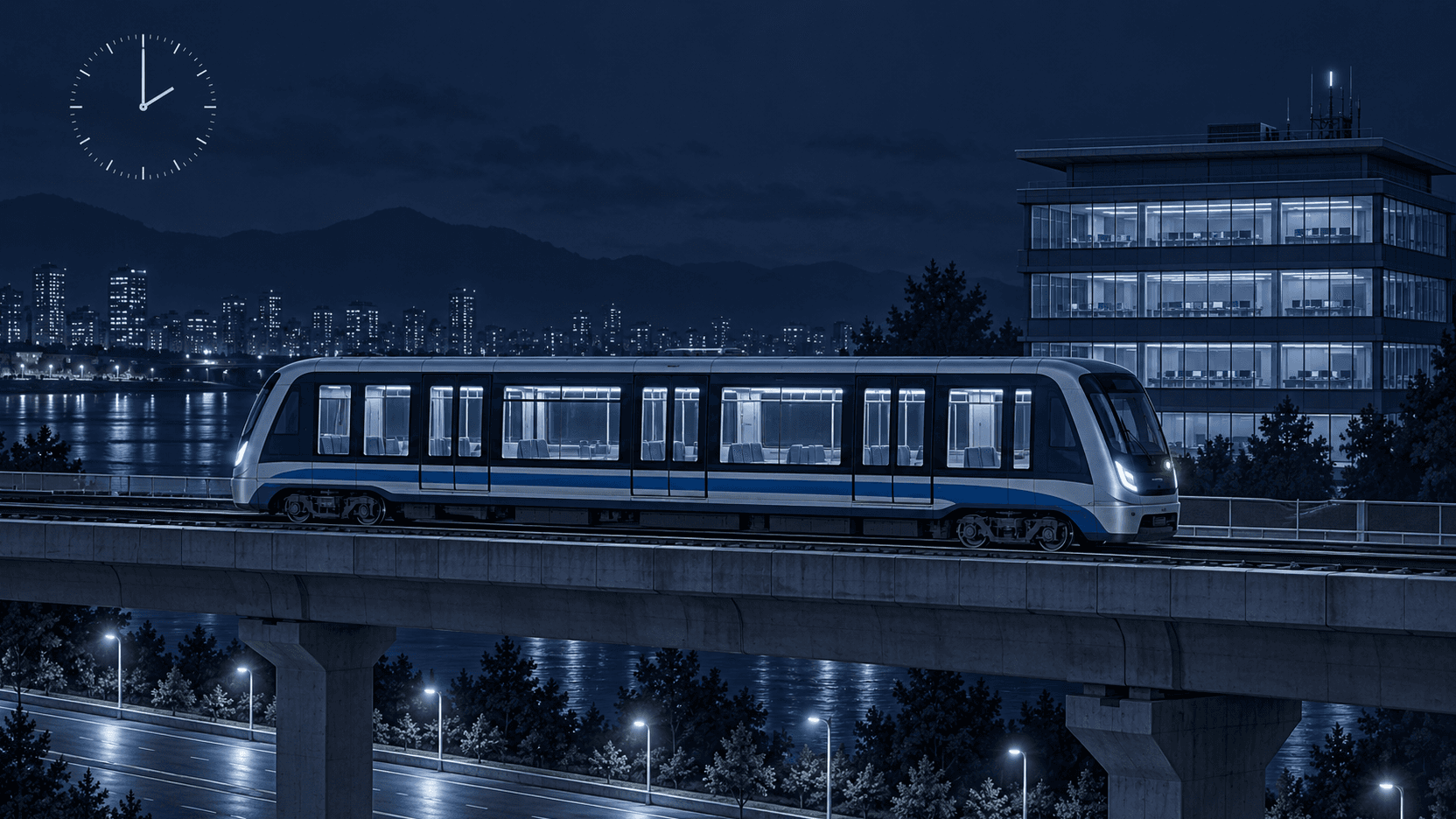

You hear it, check the clock, and assume something has gone wrong: a SkyTrain car moving along a track where nothing runs at that hour.
Nothing has. Since Saturday, October 3, 2026, SkyTrain cars have been running overnight on sections of the Expo and Millennium lines for roughly five months. Nobody is riding along. TransLink says the testing happens outside regular service hours, "with no customers aboard and no disruptions or reductions to regular SkyTrain service" — the likeliest effect on your life is the noise.
That is the honest summary, and it is also easy to misread, because three different stories about the same trains are being conflated right now. There is a rehearsal, which is what the trains are for. There is a real service disruption on those same lines that has nothing to do with the overnight noise but is already affecting actual trips. And there is a multi-year program that explains why anyone would be running trains for an empty railway in the first place. Sorting the three apart is most of what the 2 a.m. rumble actually means.
The rehearsal: a new control room learning to run the railway
The published test windows are narrow: Saturdays from 1:45 to 5:45 a.m., Sundays from 1:45 to 6:45 a.m., and some Mondays from 12:45 to 4:45 a.m. All types of SkyTrain cars take turns. Testing rotates between locations across Metro Vancouver rather than working the same neighbourhood every night, and TransLink says alarms and announcements will be suspended wherever possible.
The image is this article's own, not one borrowed from any headline: ghost trains — driverless cars moving along tracks at an hour when no one is waiting for them. The accurate framing is less clickable: homework.
The assignment is the new Operations Control Centre going up near Edmonds Station in Burnaby. Today's control room opened in 1985, when the system ran a single line, and the network has grown to roughly four times its original size since — the current facility is the first expansion of SkyTrain's operations-control space in those four decades. The replacement spans more than 40,000 square feet over four floors, with a control-room floor about the size of a basketball court, and TransLink calls it the largest technology upgrade in SkyTrain history.
The overnight windows are how a safety-critical operation swaps brains without touching the schedule. During testing, the new centre gradually takes control of trains and works through regular daily service, routine maintenance, and emergency-response scenarios before it goes fully operational, which TransLink targets for 2027.
So the empty train at 2 a.m. is a dress rehearsal, and the audience is mostly just ears.
The disruption you can actually feel: single-tracking on the east Expo Line
Here is where "no impact on service" needs an asterisk, and the asterisk is not about testing.
Right now, on the same Expo line, significant service-pattern changes are in effect affecting Production Way–University, Lougheed Town Centre, Braid and Sapperton stations. Between Braid and Lougheed Town Centre, trains alternate in both directions over a single open track while crews rebuild that stretch to connect the new Coquitlam storage and maintenance facility. TransLink tells riders to allow extra travel time and to watch directional signs and digital screens, because platform assignments have changed.
The end date is a moving target on TransLink's own pages: the program page says the changes run "until late 2027," while the facilities page anticipates regular service resuming in summer 2027 in one notice and lists fall 2027 as the track work's expected completion in another. The defensible reading is that the single-tracking continues well into 2027 — and if you build your commute around that corridor, re-check the live page before trusting any end date.
None of this is caused by the test trains. But it is why the overnight noise deserves a clear head rather than an alarmist one: the corridor is already changing under riders, and the rehearsal is what changes next.
The multi-year reason: more than 20 km of new SkyTrain by 2029
The expansion program exists because the railway is about to get much bigger, and the control room has to grow first to handle it. By 2029, the province-built Broadway Subway and Surrey Langley SkyTrain extensions will add more than 20 kilometres of SkyTrain to the region — TransLink's release puts the Broadway Subway Extension first, "next year" (2027), with the Dave Barrett (Surrey–Langley) Extension following in 2029.
Supporting that growth is why the program also includes new, higher-capacity trains, station and power upgrades on the Expo and Millennium lines, and the 27-acre facility between Braid and Lougheed stations in Coquitlam — TransLink's first major storage and maintenance expansion in decades, due in 2029, adding roughly 60 per cent to yard storage capacity and about 75 per cent to maintenance capacity, connected to the elevated guideway by a new 500-metre track.
You do not have to track all of that. One bookmark is enough: the SkyTrain Expansion Program page on translink.ca — plus TransLink's Transit Alerts sign-up if your commute lives on the east Expo line.
The SkyTrain Night-Test Field Card
When the train is loud enough to notice, this is the whole triage:
- Heard or saw overnight trains? Compare against the published windows — Saturday 1:45–5:45 a.m., Sunday 1:45–6:45 a.m., some Mondays 12:45–4:45 a.m. — and remember the sections rotate. TransLink has not published an advance per-night location schedule, so nobody can honestly tell you whether your street gets a Thursday.
- Worried about your trip? The testing is, in TransLink's own words, outside regular hours with no disruptions or reductions to regular service. If your line is genuinely disrupted, that is a separate event — confirm it on the live service-alerts page or Trip Planner rather than inferring from noise.
- Riding between Braid and Lougheed Town Centre? That is the real, current change: single-track operation, changed platform assignments, extra time. Check the signs every trip until regular service resumes.
- Troubled by the noise? The documented feedback channel is TransLink Customer Information at 604-953-3333, open daily from 6:30 a.m. to 10 p.m. The published mitigations are rotation and suspended alarms; there is no published promise of quiet.
- Want the longer view? Bookmark the SkyTrain Expansion Program and SkyTrain Facilities pages to track the control-centre cutover, the Coquitlam facility, and the extension milestones.
A quiet conclusion, mostly
The empty overnight trains are the part of this story with the least effect on your commute — and the biggest hint of what the commute is becoming. The rehearsal is scheduled to finish by early 2027 on TransLink's own five-month clock. The east-end changes do not end then; they run into the same year and past it on the program's own wording. If you take one thing from a 2 a.m. rumble, make it this: nothing has gone wrong, the system is growing up, and the practical question is not why the train is running — it is whether your station's platform assignment is still the one you remember.
Sources
- TransLink: SkyTrain begins overnight testing ahead of major network expansion (media release, Sep 29, 2026)
- TransLink: SkyTrain Expansion Program
- TransLink: SkyTrain Facilities
- TransLink Buzzer: The future of SkyTrain — a sneak peek at our new Operations Control Centre (Sep 17, 2026)
- Daily Hive Urbanized: SkyTrain begins five months of overnight tests (corroboration only; no draft claim relies on it)
- Peace Arch News: Overnight SkyTrain car testing starts (corroboration only; headline date typo — TransLink's Oct. 3 date is used)