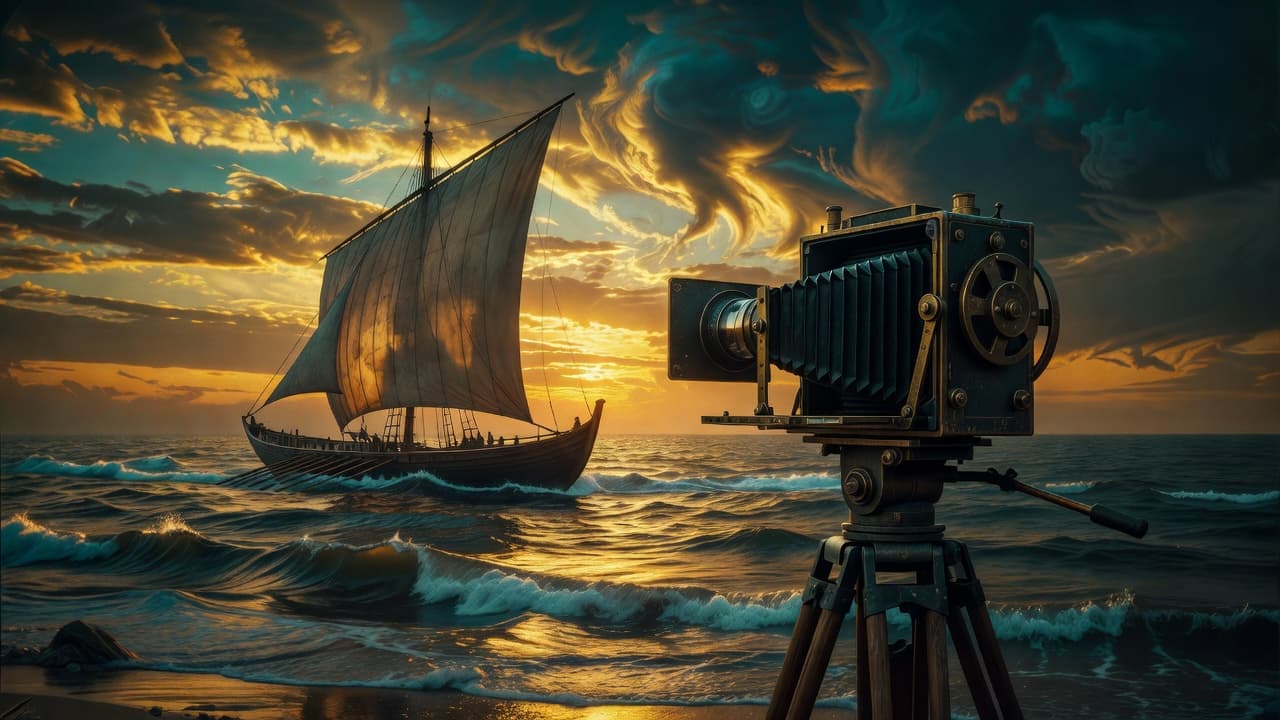

Tuesday night, Cineplex Brentwood. Lights down, phone off, drink within reach, and a commitment: two hours and fifty-two minutes, no leaving, no second screen.
I cannot remember the last time I gave a movie those terms up front. But The Odyssey is not most movies, and I wanted it the way it was designed to be seen — opening week, big screen, full attention.
A year of waiting for a ticket
Christopher Nolan's adaptation of Homer opened July 17, and the strangest thing about it happened a year earlier: tickets went on sale twelve months before release, reportedly the first time that has ever been done for a film. People bought them anyway. I get it.
This is the first feature ever shot entirely on IMAX's 70mm film cameras — not parts of it, the whole thing, across Morocco, Greece, Italy, Scotland, Iceland, Malta, and a studio lot, with brand-new camera hardware that IMAX built after Nolan asked them to solve the old cameras' problems. The budget is reportedly around $250 million, which makes it one of the most expensive films of his career. You can see where it went: real places, real water, real light. Nothing has the weightless sheen of a volume.
Hoyte van Hoytema shot it, Jennifer Lame edited, Ludwig Göransson scored. Matt Damon is Odysseus. Tom Holland is Telemachus. Anne Hathaway is Penelope. Zendaya is Athena. Lupita Nyong'o plays both Helen of Troy and Clytemnestra, and Robert Pattinson plays Antinous, the worst of the suitors. The casting announcements read like a festival lineup, and somehow it holds together.
Gods, played straight
What struck me first was how un-fantasy it all felt.
This is a story with a cyclops, sirens, a sorceress, and gods who meddle in person. Nolan's choice — reportedly inspired by Andrei Rublev, Ran, and the stop-motion monsters of Ray Harryhausen — was to play the mythology as a brutal, sun-bleached Bronze Age rather than a glossy fantasy. The monsters feel like things people genuinely feared. The sea feels like something that kills you. The gods feel indifferent, which is somehow scarier than malicious.
And underneath the monsters, the story is shockingly plain. A man spends ten years fighting a war he helped start, then ten more years trying to get home, while back in Ithaca his wife holds off a house full of men who want his throne and his wine. Odysseus's superpower was never strength. It was endurance, and the willingness to be clever when being strong stopped working.
Twenty-eight centuries later, that still lands. Everyone has some version of: the plan is broken, the conditions are unfair, keep rowing.
The theater was the point
Here is the thing I keep coming back to: I did not just watch a movie Tuesday. I attended one.
The screening had the energy of a first-week crowd — people who had planned this, who had read that the film carries a photosensitive-viewer advisory for its flashing-light sequences, who settled in like it was an event. When was the last time a Tuesday showing felt like that?
Nolan has spent his career arguing that the theatrical experience is the format, not the advertisement for the format. With this one, the argument is almost unfair. The film was composed for IMAX's expanded aspect ratio — the full 1.43:1 on the handful of true 70mm IMAX screens, 1.90:1 elsewhere. Even the "elsewhere" version, projected properly on a big screen, hits differently than any living room can. Some images are built to be larger than you are.
And audiences are voting with their wallets the same way I did: the opening weekend reportedly cleared $264 million globally, more than Oppenheimer's first weekend, and it passed $300 million worldwide inside its first week. In a cautious box-office year, a three-hour Greek epic walked in and cleared the room. People will still show up. They just need a reason that cannot be paused.
Three hours, no phone, no regrets
Somewhere around the two-hour mark I realized I had not thought about my phone once. Not willpower — the film simply never gave me a gap to slip into. That is becoming rare enough to count as a life event, honestly. A three-hour runtime used to be a warning label. This one felt like a gift: enough time to actually be somewhere.
I walked out into the parking lot near ten, a little dazed, a little hungry, completely satisfied — the specific satisfaction of a story that is old enough to know what it is about. Homer has been adapted a hundred ways, usually badly, usually cheap. This one cost a quarter of a billion dollars and a year of waiting, and it spent both on the thing that matters: making a 2,800-year-old campfire story feel like it is happening to you, in the dark, at scale.
So here is my unsolicited advice: do not stream this one when it lands. Do not watch it half-attention on a TV that is also handling laundry notifications. Give it a screen, give it the dark, give it your full three hours.
The phone will survive without you. Odysseus took ten years to get home; your notifications can wait one evening.