
A few days ago I fell down one of those late-evening rabbit holes. It started with a dumb question: France got steamrolled by Germany in six weeks in 1940 — so when exactly did they find the time to build nuclear weapons?
The answer explains something I'd never really thought about: why exactly five countries on Earth are legally allowed to have nukes, and everyone else gets sanctions.
France was early, then late, then sneaky fast
Here's the part that surprised me. Before the war, Paris was arguably the world capital of nuclear physics. Frédéric Joliot-Curie — Marie Curie's son-in-law — had a Nobel Prize, and in early 1939 his lab was one of the first to show a chain reaction was physically possible. In 1940, France bought Norway's entire stock of heavy water, a key reactor ingredient, and smuggled it to Britain days before the Germans arrived.
Then France fell, and that was that. Joliot-Curie stayed in Paris and quietly stalled, feeding the occupiers nothing useful. The real program happened after the war, and the motivation is right there in the history: never be helpless like 1940 again. De Gaulle created the atomic energy commission in 1945. First reactor in 1948. The Suez Crisis in 1956 — watching the US and USSR flex while France got told to stand down — pushed the weapons work into overdrive. And on February 13, 1960, France detonated "Gerboise Bleue" in the Algerian Sahara: 70 kilotons, roughly four times the Hiroshima bomb, still the biggest first test any country has ever done. Fourth nuclear power. Hydrogen bomb by 1968.
Not bad for a country that got flattened in six weeks.
The January 1, 1967 cutoff
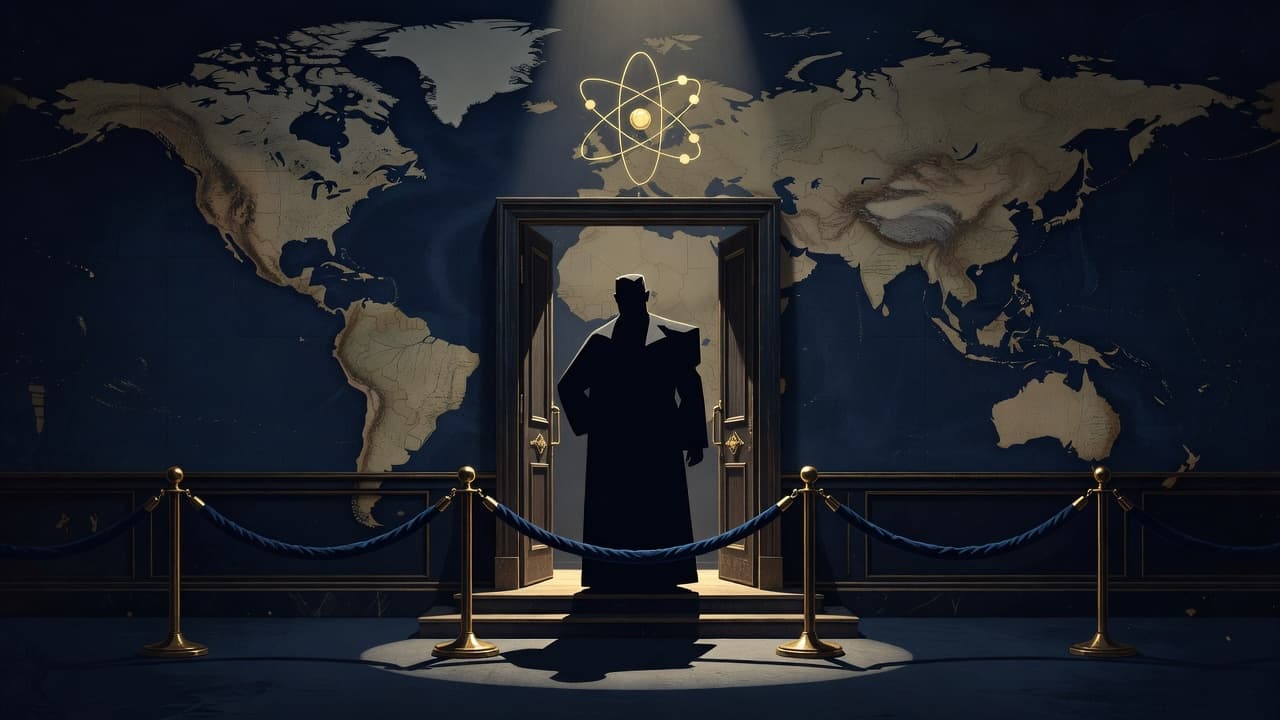
Now here's the rule that runs the world. The Nuclear Non-Proliferation Treaty — opened for signature in 1968, in force since 1970 — defines a "nuclear-weapon state" as any country that manufactured and exploded a device before January 1, 1967.
Exactly five countries made the cutoff: the US (1945), the USSR (1949), the UK (1952), France (1960), and China (1964). Notice anything? Those are also the five permanent members of the UN Security Council. The treaty basically said: the five of us are legal forever, everyone else — the door is now closed. Peak "rules for thee" energy. But here's the uncomfortable part: it mostly worked. Since 1970, only India, Pakistan, and North Korea have openly tested; Israel almost certainly has them but plays the "no comment" game. The optimists of the 1960s predicted dozens of nuclear states by now. We got four extra.
France being France, by the way, didn't actually sign the NPT until 1992 — over twenty years late. They also declined to sign the 1963 Partial Test Ban Treaty and kept atmospheric testing until 1974, first in Algeria, then in French Polynesia. Very de Gaulle, decades after de Gaulle.
So can a country just... build one anyway?
That was my follow-up question, and the answer is: technically yes — that's not a loophole, it's how the system works. Treaties only bind you if you signed them, and even then, there's an exit door.
There are three "legal-ish" paths:
- Never sign. India, Pakistan, Israel. You can't violate a contract you never signed. Zero legal violation, just decades of angry diplomatic letters.
- Sign, then quit. The NPT has a built-in withdrawal clause: three months' notice, walk. North Korea did exactly that in 2003, then tested in 2006.
- Cheat. Break the treaty and eat the consequences — which are the actual deterrent, not the paper. Sanctions that strangle your economy, export controls that starve your program, and the spicy option: someone bombs your facilities. Israel flattened Iraq's reactor in 1981 and Syria's in 2007.
There's also the sneaky middle ground: the "threshold state." Japan, Germany, South Korea, Brazil all have the tech and material to build a bomb in months if they ever chose to. Japan is famously "a screwdriver's turn away." Completely legal — you only cross the line when you weaponize, not when you enrich for reactors.
The real wall is a machine, not a treaty
This was my favorite part of the rabbit hole. Designing a crude nuke is 1940s physics you can find in textbooks. The hard part is getting the material.
Natural uranium is 99.3% U-238 (useless for bombs) and 0.7% U-235 (the good stuff). Same element, identical chemistry — no reaction can separate them. The only difference is U-235 is about 1% lighter. You have to sort trillions of atoms by a 1% weight difference, from 0.7% purity to around 90%.
So you turn the uranium into a gas and spin it in centrifuges at roughly 100,000 RPM. The slightly heavier atoms get flung outward slightly more, each pass enriches the gas by a tiny amount, so you chain thousands of machines in cascades for months. The engineering is so delicate that a grain of dust can shred a rotor — which is exactly why Stuxnet, the worm that made Iran's centrifuges spin themselves to death while reporting "all good" to the operators, worked so well. The machines are the vulnerability.
And the ore? Basically irrelevant. Uranium is all over the place — Kazakhstan, Australia, Canada, Niger. North Korea has major domestic deposits and still needed smuggled centrifuge designs from A.Q. Khan's black-market network. Even my own home country allegedly dabbled: around 2009-2010, defectors leaked claims that Myanmar's junta was buying machine tools via North Korea for some kind of program near Naung Laing. The IAEA's verdict: the ambition was maybe real, the capability was not. It quietly died, and Myanmar signed deeper inspection agreements in 2013. Having uranium in the ground turns out to be about 5% of the way to a bomb.
The honest ranking of barriers: ore < chemistry < precision machines < not getting noticed by satellites < affording any of it. The non-proliferation regime isn't really a legal system. It's physics plus surveillance plus bankruptcy.
The door is rattling again
And here's why this isn't just history. In March this year, Macron stood in front of a ballistic missile submarine in Brittany and announced France will increase its warhead count — the first expansion since 1992 — and will stop disclosing the size of the arsenal. Eight European countries, including Germany and Poland, signed up for a new "forward deterrence" posture that could see French nuclear-capable jets temporarily deployed across the continent. France sits at roughly 290 warheads today, the world's fourth-largest arsenal, mostly on submarines.
The country that built the bomb so it would never depend on anyone again is now quietly offering to be Europe's umbrella — because Europe is no longer sure about America's. Sixty years after Gerboise Bleue, the logic hasn't changed. Everyone wants what de Gaulle wanted: the certainty that nobody can tell you to stand down.
The NPT didn't ban nuclear weapons. It froze a 1967 leaderboard and called it a legal order — held together with centrifuge export controls, satellite photos, and the occasional airstrike. Watching that leaderboard wobble in 2026, I'm not sure which is more impressive: that the club stayed at nine members this long, or that we built the whole thing on a treaty with a three-month cancellation policy.