
The most dangerous political rumours are not always the ones that sound impossible. They are the ones that arrive with just enough plausibility to make your stomach drop before you have had time to ask where they came from.
This week I saw people worrying that Donald Trump was planning to stop future elections in the United States. It is the kind of sentence that spreads perfectly online: short, terrifying, and easy to repeat. I live in Canada, so I have some distance from the machinery of American politics, but not enough distance to treat what happens south of the border as somebody else's weather. The United States is too close, too influential, and too loud for that.
My first reaction was basically the sensible human one: that is crazy. My second reaction had to be: what, exactly, is being claimed here?
That distinction matters more than it sounds. A claim that an election has already been cancelled is not the same as a claim that a politician has used authoritarian language. Neither is the same as a concern that institutions could be pressured, weakened, or manipulated over time. If we flatten all of those into one giant red-alert sentence, we make it harder to see the actual danger clearly.
The boring mechanics are reassuring for a reason
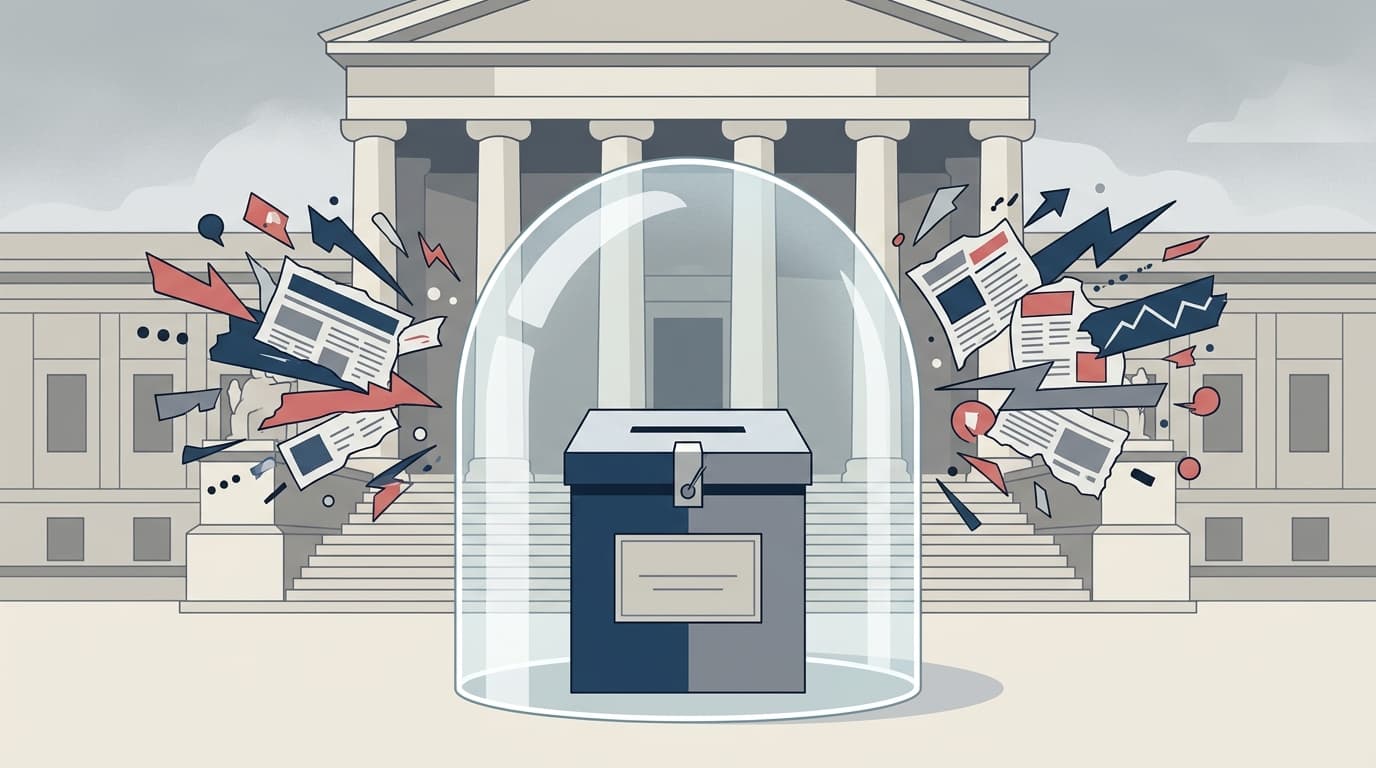
The immediate, concrete fact is that the 2026 U.S. midterm elections are still scheduled for November 3. Every House seat is due to be contested, along with a large share of Senate seats. That schedule is not a calendar reminder controlled by one person in the White House. Federal election timing comes from law, congressional terms are set by the Constitution, and elections are administered through a sprawling state-by-state system.
That is not a guarantee that everything will be graceful or fair. It is simply a reason to reject the lazy version of the story: that a president can wake up, announce “no more elections,” and make the whole thing legally disappear by lunchtime.
The system has multiple points where a unilateral order runs into something harder:
- Congress has its own constitutional life and its own election timetable.
- States run the practical machinery: voter registration, ballots, polling places, counting, and certification.
- Courts can block unlawful action, even when the process is stressful and slow.
- Officials, judges, election workers, journalists, and voters are not decorative extras. They are part of the system's resistance to abuse.
None of that is glamorous. It is mostly deadlines, state law, court filings, and people doing jobs that only become famous when something goes badly wrong. But boring infrastructure is often what keeps a democracy from being turned into one man's mood board.
Reassurance is not complacency
There is a trap on the other side too. Once someone proves that the most dramatic version of a claim is false, they sometimes act as if the underlying concern must be silly. That is not how this works.
Democratic backsliding rarely begins with a clean announcement that says, “Hello, I am ending democracy now.” It shows up as a pile of smaller moves: attacking the legitimacy of elections before votes are cast, pressuring officials, making it harder for some people to participate, treating courts as enemies when they rule the wrong way, and training supporters to accept only one kind of result as real.
Those things are worth taking seriously precisely because they are easier to normalize. A cancelled election would be an obvious constitutional crisis. A constant fog of suspicion around election workers is less cinematic, but it can do real damage. So can political violence, intimidation, and the habit of treating every loss as proof that the game was rigged.
I do not need to pretend that every alarming clip proves an imminent dictatorship to think this is bad. In fact, I think exaggeration makes the serious argument weaker. It hands an easy win to anyone who wants to dismiss all concern as panic.
The stronger position is more demanding: say what is true, say what is uncertain, and keep your eyes on the real pressure points.
A better question than “is this crazy?”
When a political claim starts ricocheting around, I am trying to ask four questions before I let it occupy too much space in my head:
- What did the person actually say or do, in the full context rather than a screenshot?
- What legal power do they really have, and what other institutions have to cooperate?
- Is this a confirmed action, a proposal, a threat, a pundit's prediction, or somebody else's inference?
- If the claim is overstated, what is the smaller but still real issue underneath it?
That last one is the useful question. Sometimes the answer is “nothing much; the post was just nonsense.” Other times the headline is wrong but the pattern deserves attention. We should be able to hold both thoughts without short-circuiting: no, this specific thing has not happened; yes, attacks on democratic norms can still be dangerous.
There is also a personal reason I care about that discipline. Fear is efficient. It makes us share before we check, choose teams before we understand, and feel briefly informed because we have memorized the scariest possible version of a story. But fear is terrible at detail. It does not tell us which institution matters, which deadline matters, or what would actually change the outcome.
Facts do not make politics less emotional. They make the emotion useful.
Attention is part of the job
I do not have a grand conclusion here beyond a slightly unfashionable one: attention is civic work. Not doomscrolling. Not pretending every absurd post is harmless. Actual attention.
For me, that means refusing the fake comfort of “it could never happen here,” while also refusing to let a viral sentence do all of my thinking for me. The institutions that protect elections are real, but they are not self-maintaining. They depend on people noticing when rules are bent, on officials doing their jobs, and on voters caring enough to show up before a problem becomes irreversible.
Being alarmed can be rational. Being certain before the evidence is there is something else. In an age built to keep us frightened and scrolling, can we learn to tell the difference?