
I needed a batch of classic quotes recently, for a small feature in a side project — the kind of short, well-worn lines people have been quoting for a few thousand years. Nothing exotic. A verse from Proverbs. Something from Confucius. A line from the Tao Te Ching. That sort of thing.
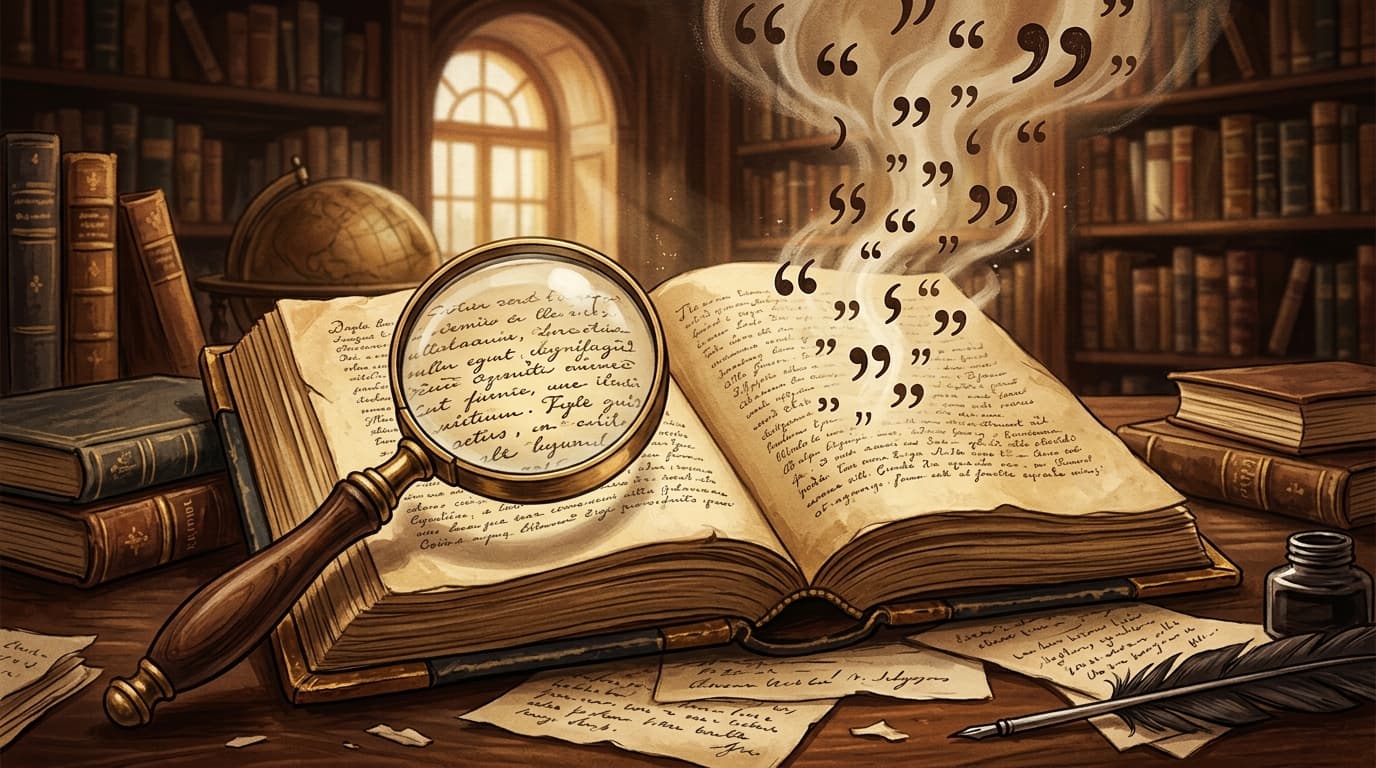
I could have grabbed them from any quote website and been done in five minutes. Instead I did something that felt faintly ridiculous even as I did it: I opened the actual source texts — the public-domain editions on Project Gutenberg, the classics archive at MIT, the King James Bible — and checked every single quote against the original, word by word.
Fourteen quotes. Four of them were wrong.
The boring rule that caught it
The rule is simple and unglamorous: don't trust a quote unless you've seen it in the thing it came from. Not in a listicle, not in a database, not in the caption of an image with a sunset behind it. In the book.
It's a rule I've always known in the abstract — "always check primary sources" is up there with "floss daily" as advice everyone agrees with and almost nobody follows. But I'd never actually applied it to something as low-stakes as a handful of quotes, because quotes feel settled. They're old. They've been repeated so many times that surely, by now, somebody would have fixed the mistakes.
That turns out to be the whole problem. Everybody repeats; almost nobody checks.
Four quotes, four ways to be wrong
The four errors weren't even the same kind of error. That was the surprise. Misquotation isn't one failure mode — it's several, wearing the same clothes.
A missing word that changes the meaning. The Analects quote I had said "a superior man." James Legge's translation — the standard English version for over a century — actually says "the superior man." One word, but it's the difference between "one example among many" and "the category itself." Confucius isn't describing a type of person among others; the whole apparatus of his teaching hangs on what the superior man is.
A quote that started mid-sentence. My Tao Te Ching line began in the middle of a thought. Legge's actual translation opens further back: "The tree which fills the arms grew from the tiniest sprout" — and keeps going, up to the tower of nine storeys. Start it one clause too late and you've amputated the point, which was that big things grow from small beginnings, and kept only the conclusion.
A gloss that got dropped. A verse from the Dhammapada, in Max Müller's classic translation, carries a parenthetical — "(Buddhas)" — that Müller added as a translator's clarification. Somewhere along the line it vanished. Small thing, except the gloss is what tells you the verse isn't generic advice; it's pointing at a specific tradition.
A verse that was only half there. Proverbs 24:16, the one everybody knows: "a just man falleth seven times, and riseth up again." That's the part that gets quoted. The full verse keeps going: "but the wicked shall fall into mischief." I'd had only the first clause. In fairness, the second half is awkward out of context — which is probably why everyone quotes half of it.
Four different errors. None of them malicious. All of them the natural byproduct of quoting from memory, or from each other.
Why quotes drift
The mechanism is basically the game of telephone, stretched across centuries and languages.
A quote starts as a translation, and translation is already lossy — every choice a translator makes is one of many possible choices. Then it gets excerpted, so context drops away. Then it gets paraphrased from memory, so words swap and articles go missing. Then it gets copied into a database, which gets scraped into another database, and after enough hops the "quote" is a smoothed, half-remembered version of a version of a version.
And here's the uncomfortable part: none of the errors I found were even wrong in a way that matters for a greeting card. "A superior man" instead of "the superior man" is the kind of difference that only matters if you're trying to say something true about what Confucius actually taught. For most uses — a bit of flavor, a decorative line — the drift is harmless.
It's only when the quote is doing real work that the gap bites. When it's the thing you're pointing at for wisdom, the difference between "what he said" and "what we remember him saying" stops being trivia.
What checking actually costs
So what did the verification buy me? Four corrections out of fourteen, which is a worse error rate than I'd have guessed. And a cleaner conscience about every quote that did check out.
But the real takeaway wasn't about quotes. It was about the seductive lie of the settled fact. The quotes felt stable because they're famous. They'd been repeated so often that the repetition itself felt like verification. It isn't. Repetition is just popularity, and popularity has never once corrected a typo.
The next time you lean on something because "everyone knows it" — a quote, a statistic, a story about how a thing got its name — ask yourself when you last checked it against the place it came from. It's a five-minute habit that mostly returns "yep, that's right," and occasionally returns a small, valuable surprise.
Most of what we quote, we've never actually read.