
It started with a dumb question: is the government actually doing anything about wildfires, or do we all just accept that summer smells like a campfire now?
I live in BC, so this is not abstract. 2023 was Canada's worst fire season on record — over 165,000 square kilometres burned. 2025 was the second-worst, with nearly 90,000. This year was forecast above average again, and as of mid-July there were close to 900 active fires across the country. So I went looking for the real policy answer, fully expecting to find thoughts and prayers. Instead I found a genuinely interesting rabbit hole — and I lost an argument with myself along the way.
What they're actually doing
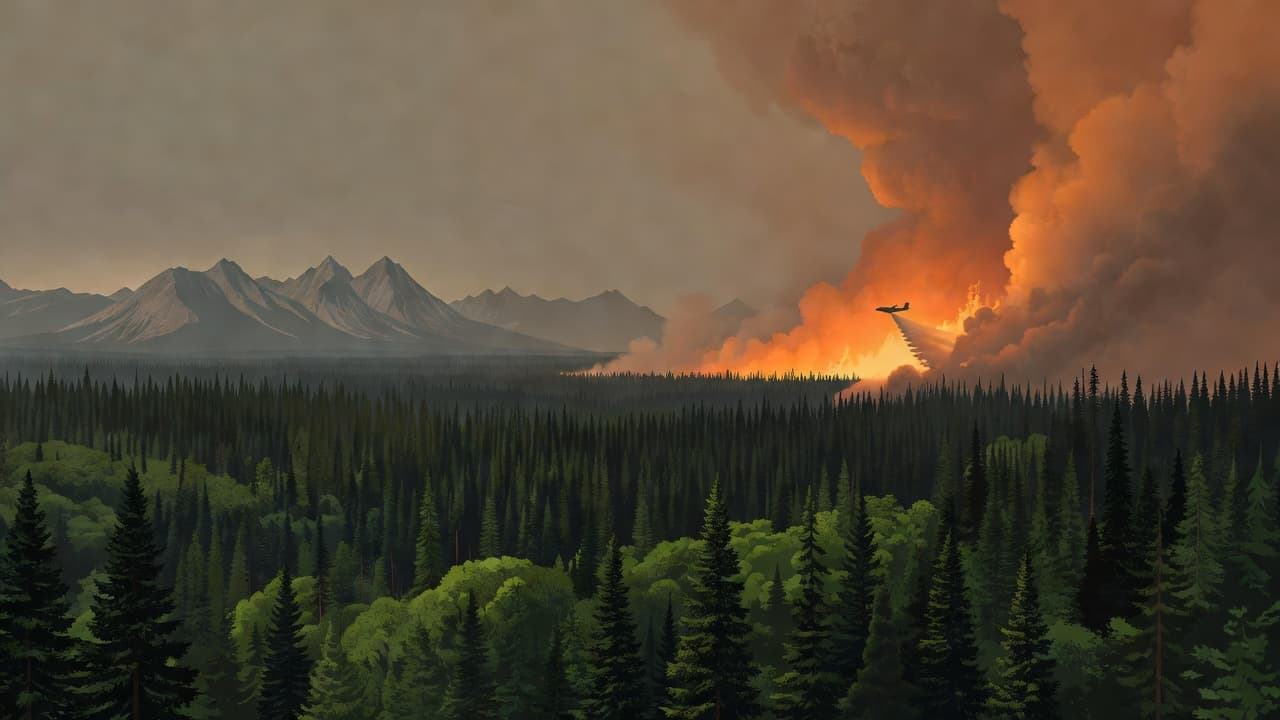
The headline: Canada now has its first-ever national aerial firefighting fleet. Through Budget 2025, the feds put $316.7 million over five years into the Canadian Interagency Forest Fire Centre, which leased ten aircraft for the 2026 season — four air tankers, a spotter plane, five heavy-lift helicopters, all from BC-based companies — prepositioned around the country wherever fire activity is forecast. Until now, provinces each ran their own fleets and borrowed from each other when things got bad.
Good. Genuinely. But notice what it is: response. More water bombers for when the forest is already on fire. Which is where my argument came in.
My position: prevention can't scale
My take going in: Canada is too big for prevention. Hundreds of millions of hectares of forest, and fires only start in a tiny fraction of it — so isn't response the pragmatic spend, as sad as it is about the trees?
Then I learned what prevention people actually mean, and my argument fell apart in about ten minutes.
Nobody is proposing to rake the boreal forest. What matters is the wildland-urban interface — the band where forest meets towns. Fort McMurray. Jasper. Lytton. Kelowna. That zone is a sliver of the country's land area, and treating the fuel in it — thinning, clearing brush, prescribed burns in buffer zones — is a finite, achievable job.
The math is brutal. The fire-economics rule of thumb is that a dollar of prevention saves roughly four to six dollars of response and recovery. Suppression alone now regularly tops a billion dollars a year nationally. Fort McMurray's total impact was around $9 billion — the most expensive disaster in Canadian history. Response feels cheaper only because the bills arrive labeled as emergencies instead of budget lines.
The worst fires don't just burn forest — they erase it. Burn hot enough and you sterilize the soil, and what comes back isn't forest. We're not choosing between burnt and unburnt; we're choosing between fires that forests recover from and fires they don't.
So "react everywhere" isn't the cheap option. It's the expensive option with worse outcomes, wearing a fiscal-responsibility costume.
The cheapest prevention tool is a match
Here's the genuinely counterintuitive part: the cheapest prevention is fire. Prescribed burns — small fires lit on purpose, in spring or fall, under safe conditions — clear the fuel on your terms. Indigenous nations did this here for thousands of years. Then Canada criminalized it. Fire suppression was colonial policy for a century, and now there's a genuine shortage of qualified burn bosses, because we spent generations stamping out the exact expertise we desperately need.
So why isn't everyone burning? Follow the incentives. An agency schedules a burn; smoke drifts over a town for a few days; the phones melt; the mayor gets heat; the agency gets gun-shy; the fuel keeps building. Add liability: one escaped burn — New Mexico, 2022 — and there are lawsuits, hearings, ended careers. But if a wildfire destroys a town? Act of God, nothing anyone could do. Every individual decision-maker is rationally incentivized to never light the match — which collectively guarantees the megafire.
The US Southeast mostly solved this: states passed "right to burn" laws that shield certified burners who follow approved plans, and they burn millions of acres a year. Canada has no equivalent armor. My instinct — if the science says it works, just do it, forget the complainers — turns out to be legally impossible until someone builds that shield. It's not cowardice. It's a missing law.
And the political math is worse. A mayor who approves a burn that smokes out town for three days loses the next election. A mayor whose town burns down in year eight cries on camera, declares a state of emergency, and gets re-elected for their leadership during the crisis. Nobody cuts a ribbon for a disaster that never happened. We chose smoke-free springs for decades, and we got inferno summers.
Yes, one spark. And yes, space is watching.
Two smaller things I picked up along the way.
Fires really do start from one spark — but lightning is the heavyweight. It causes about half of Canada's fires and roughly 80% of the area burned, because strikes hit remote forest where a fire grows for hours before anyone sees smoke. Dry lightning — storms where the rain evaporates before landing — can start dozens of fires in one night. And "holdover" fires smolder underground in roots and duff for days or weeks before popping up like zombies. Nature is cheating.
As for watching from space: we already do — MODIS, VIIRS, geostationary satellites — and detection is honestly close to a solved problem. The fresh news is from this month: the first three operational FireSat satellites, a Google-backed constellation purpose-built for wildfires, launched on July 7. They see through smoke, spot fires as small as five by five metres, and cover every fire-prone region at least twice a day. Meanwhile Canada's own WildFireSat — meant to be the first government-owned wildfire constellation — had its build contract cancelled "for convenience" this spring, with launch still targeted for 2029. Make of that what you will.
But even perfect detection doesn't put water on a fire three hundred kilometres from the nearest crew in the middle of a heat dome. Response capacity is the bottleneck — which loops right back to the fleet, and to prevention.
The takeaway
I went in arguing that prevention was a luxury and response was the pragmatic spend. I came out thinking we have it almost exactly backwards. We massively over-invest in the heroic, televised end of the problem — the water bombers, the evacuations, the smoke maps on the news — and starve the boring, invisible end that actually works: fuel treatment around towns, prescribed fire, liability shields for the people willing to light the match.
The technology to watch every fire in near-real-time launched two weeks ago. The knowledge of how to prevent the worst fires is thousands of years old. The only missing ingredients are a law, a budget line, and a public willing to tolerate three smoky days in April to avoid three apocalyptic weeks in August.
So which is the cheaper country to live in: the one that smells faintly of controlled smoke in the spring, or the one that burns on the news every summer?