
Leaves create three different jobs in Vancouver, and treating them as one is where the trouble starts. There is the household collection schedule. There is the City’s separate street-leaf program. And there is the very limited, safety-first response to a visibly blocked catch basin.
They can all arrive in the same soggy week. They are not the same instruction.
Environment and Climate Change Canada’s current Vancouver forecast includes rain or showers across several upcoming days, including the weekend, so this is a useful moment to make a small plan rather than a heroic one. Forecasts move; the card below still works after this one changes. It is for City of Vancouver green-bin customers, not a Metro-wide pickup promise.
The Five-Minute Leaf-and-Drainage Card
Save this somewhere more useful than a browser tab with 46 siblings.
Find the right service first. Check your address in VanCollect or the City’s collection schedule. The City currently lists extra-leaf weekends on different dates for north and south collection zones. Do not borrow a neighbour’s schedule, and definitely do not assume another municipality uses Vancouver’s.
Use the extra-leaf rules only on an extra-leaf weekend. For those weekends, the City says to use paper yard-waste bags or store-bought bins no larger than 100 litres; set them where garbage normally goes before 7 a.m. on Saturday. Keep paper bags dry if you can. Do not use plastic bags, including bags labelled compostable or biodegradable, and do not put out the green bin for that special pickup.
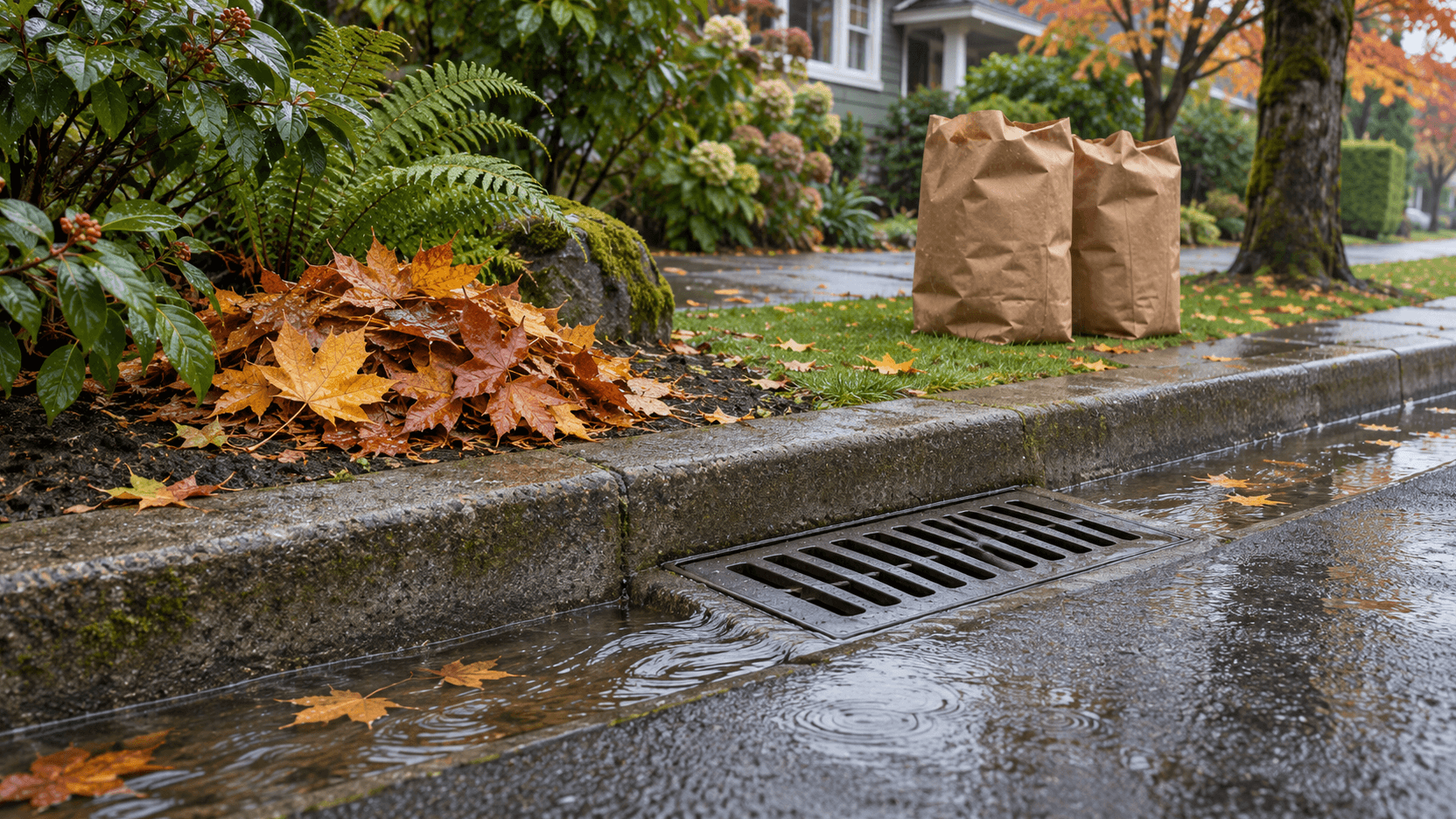
Keep the right-of-way out of the plan. Do not rake or blow leaves onto streets, sidewalks, bike lanes, or catch basins. The City says leaf piles can create slippery conditions, reduce visibility, and block drainage. A tidy yard is not much help if the tidy-up moves the problem to the curb.
Use a safe, limited drain rule. Before or after heavy rain and leaf fall, look from a safe position. If loose leaves are visibly blocking a nearby catch-basin grate, the City advises using a long-handled rake, broom, or shovel—not hands—to move debris away. Stay visible, watch for traffic, and keep out of the street whenever possible. If there are needles, broken glass, deceased wildlife, other hazardous material, or flooding you cannot safely address, stop and report it through Van311 or by calling 3-1-1 within Vancouver.
Treat street signs as a separate appointment. A temporary no-stopping sign for leaf removal is not a reminder about your green bin. If it is posted on your side of the street, move the vehicle before 7 a.m. on the date shown. The City’s map is useful for planning, but its dates are guidelines that can change with weather, road conditions, trucks, and crews. Check it again rather than treating an old screenshot as a contract.
Household pickup: the part with the calendar
The City’s seasonal leaf page currently lists November 14–15 for north collection zones and November 28–29 for south zones as its next 2026 extra-leaf weekends. That detail is time-sensitive, which is why the address check comes before the bags come out.
On a regular collection day, leaves and other yard trimmings can go in the green bin year-round. The special weekend is the exception: it is for extra leaves in paper bags or eligible bins, and the green bin stays in. That distinction is small enough to miss and annoying enough to matter.
There is also a helpful boundary here: this article is about City of Vancouver service. It does not promise a collection date for Burnaby, Richmond, North Vancouver, or any other municipality. A regional weather system does not create a regional waste calendar. Rude, but fair.
Street removal: the part with the sign and the map
The City’s street-leaf program runs from mid-November through January. Its crews remove leaves from streets; it does not replace household set-out, and it does not mean crews clear every sidewalk or boulevard.
If temporary no-stopping signage appears, the sign is the action item. Move the vehicle before 7 a.m. on the displayed date. Then use the City’s live map as a planning tool, not a promise: schedules can shift, and advance clearing may happen in heavy-leaf areas.
This is also why “I’ll just sweep the pile into the road” is the wrong workaround. The City asks residents not to rake or blow leaves into streets, sidewalks, bike lanes, or catch basins. Keep the leaves on your property or use the appropriate collection route instead.
Catch basins: a report-first job, not a street project
The City’s catch-basin guidance is deliberately modest. Check before and after heavy rain or when trees are dropping leaves. If it is safe and the obstruction is only loose debris, a long-handled tool can move material away from the curb and grate.
That is the limit of the DIY brief. Do not use your hands. Do not lift a grate. Do not enter traffic, cross mid-block, or handle anything hazardous. If a drain is causing flooding and you cannot safely clear loose debris, report the issue. The useful skill here is recognising when to stop—not proving that a rain jacket makes someone municipal infrastructure staff.
Check again before acting
Collection dates, posted signs, and the street-cleaning map can all change. Before the relevant weekend or street-work date, reopen the City links, confirm the address-specific schedule, and look at the sign on the block. If the weather changes, the safe response stays the same: keep your distance from traffic and hazards, use a long-handled tool only for loose debris when it is safe, and report what needs City attention.