
The lights go out. Your phone is at 18%, the building's electrical room is not yours to open, and you're not even sure whose name is on the power account. What now?
A renter doesn't need to control the building to make a useful outage plan. The goal is simpler: know what you can prepare, who to contact, and which problems are not yours to fix.
This is a general guide, not a live outage report. Follow emergency officials and your building's instructions when they apply. If there's an immediate danger, call 911.
In early November 2026, windstorms knocked out power across B.C.; CBC reported that more than half of the BC Hydro customers without electricity on the morning of November 8 were in the Lower Mainland and Sunshine Coast. That's a snapshot of a past storm, not a forecast. It's also a good reason to decide where the flashlight lives before the next interruption.
Before a storm: make the useful things findable
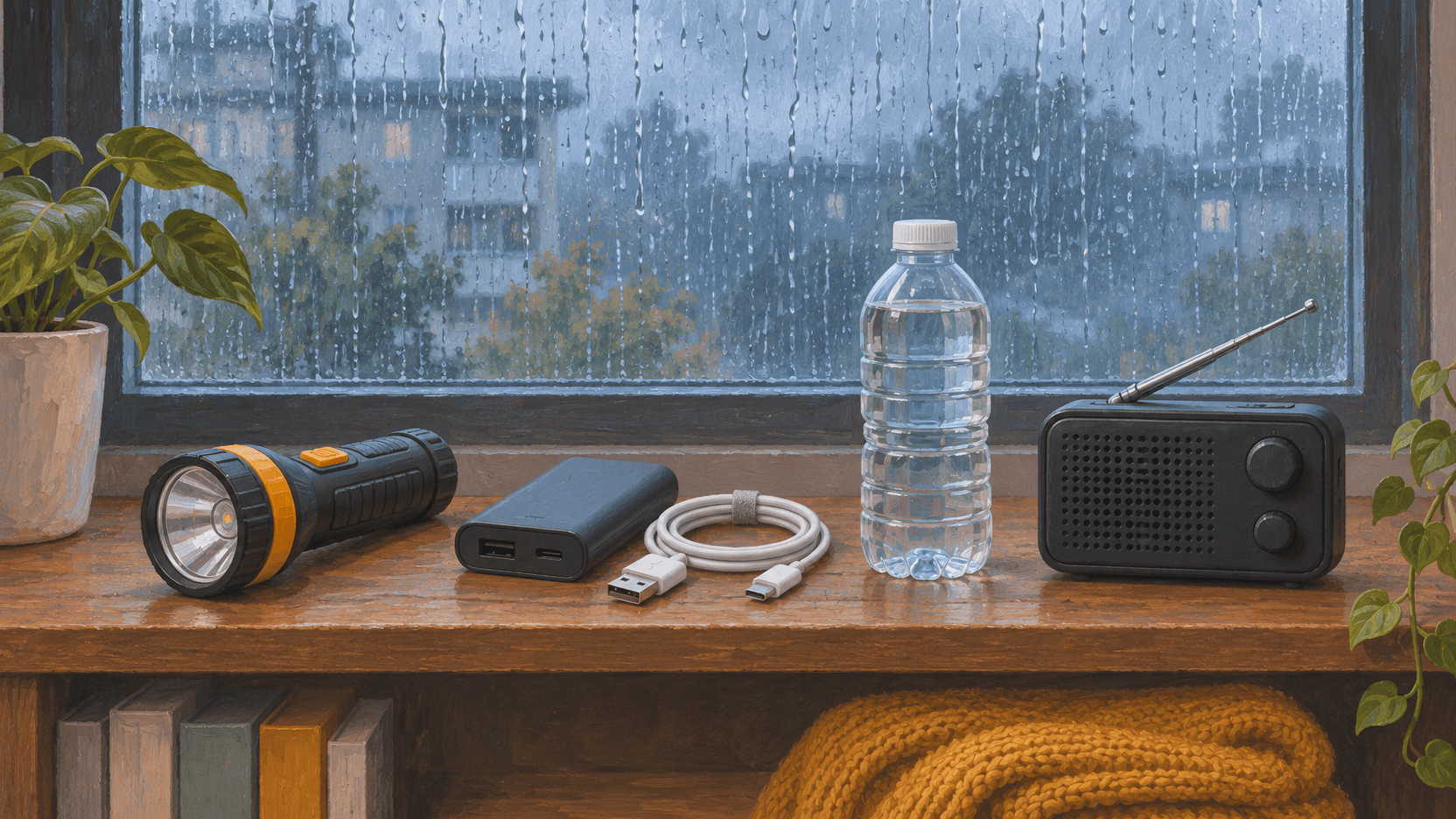
Start with a flashlight, spare batteries, a charged power bank and charging cable, a battery-powered radio, water and food that doesn't need cooking. Keep them somewhere you can reach in the dark. A light that is technically in the apartment but buried in a cupboard is not much of a plan.
PreparedBC recommends enough water and non-perishable food for a minimum of three days to two weeks, with four litres of water per person per day for drinking and sanitation. Space and budgets differ; start with what you can reasonably put together and build toward that range. Include supplies for the people and animals in your household, and consider any accessibility or other individual needs in advance. PreparedBC's linked planning guidance is a useful starting point.
Save your building manager's or owner's contact information somewhere you can find without searching your inbox. Find out which electricity provider serves the building; the BC Hydro reporting steps below apply to BC Hydro service, not automatically to every address. Bookmark your municipality's emergency information and BC Hydro's outage list if relevant. A written copy of key numbers is a useful backup when a phone needs charging.
A stay-at-home kit and a portable grab-and-go bag do different jobs. One helps you manage at home; the other is ready if officials tell you to leave. You don't have to solve every hypothetical at once. Being able to find a light and make a call is a solid place to start.
During an outage: work out who needs to know
First, check your immediate surroundings without taking risks. If it appears that only your apartment or condo unit has lost power, BC Hydro says to report it to the building manager or owner. If you can safely tell whether common areas or nearby homes have power, that may help you describe the problem; it is not a diagnosis.
Don't enter a locked electrical room, handle damaged equipment or try to repair a panel. You don't need to reset unfamiliar equipment to be allowed to ask for help. If you are unsure what is safe or accessible, contact the building manager rather than investigating further.
If the problem appears wider and BC Hydro is your provider, check its outage list or outage map. If your outage isn't listed, call 1-800-224-9376 or *49376 from a mobile phone. No BC Hydro account number? The utility says renters can stay on the line when prompted for one and will be connected to an agent.
An estimate on a map is useful information, not a promise about your particular building. Keep following updates from the provider, your municipality and building contacts, especially if an outage stretches into cold weather. Your municipality may share information about warming centres or other local services.
While you wait: keep food cold and heat sources safe
Keep the fridge and freezer doors closed as much as possible. Health Canada estimates an unopened refrigerator will keep food cold for about four hours; a full freezer will keep food frozen for about 48 hours, and a half-full one for about 24 hours. These are estimates, not guarantees that every item remains safe. Fridge and freezer thermometers can help you assess conditions.
Don't put frozen food outside, even in winter. Follow Health Canada's guidance for deciding what to keep, and don't depend on smell or appearance: food contaminated with bacteria does not always look or smell spoiled. The agency says to throw away food that has been at room temperature for two hours or more. When in doubt, throw it out.
Never use a barbecue or camping stove indoors or in an enclosed space, and never heat your home with a gas stovetop or oven. If a carbon monoxide alarm sounds or you suspect carbon monoxide poisoning, get outside into fresh air immediately and call 911. For light, BC Hydro recommends LED candles to reduce fire risk.
If you see a downed, damaged or low-hanging power line, stay at least 10 metres away and call 911. Don't approach it to take a closer look, even if it appears harmless. Give the hazard space and let the people equipped to deal with it respond.
BC Hydro also asks customers to turn off electric heaters and major appliances and unplug sensitive electronics during an outage. Leave one inside light on so you can tell when power returns. Do only what is safe and accessible in your own home; there is no reason to reach into a locked room or handle damaged equipment.
After power returns: don't rush the reset
The lights coming back are the beginning of the check, not the whole check. BC Hydro advises against immediately switching on heating and numerous appliances and electronics at once, to give the electrical system a chance to stabilize.
Check food using Health Canada's current guidance rather than treating the clock estimates as a blanket safety test. Reset any clocks, timers and alarms you rely on, recharge your power bank, and replace supplies you used. If a problem still appears limited to your unit, tell the building manager or owner rather than assuming the wider restoration fixed it.
The renter-friendly version of preparedness isn't complicated: make the essentials accessible, know your reporting route, and leave electrical repairs to the people responsible for them. A few decisions made in daylight are easier than trying to make all of them with a nearly dead phone.