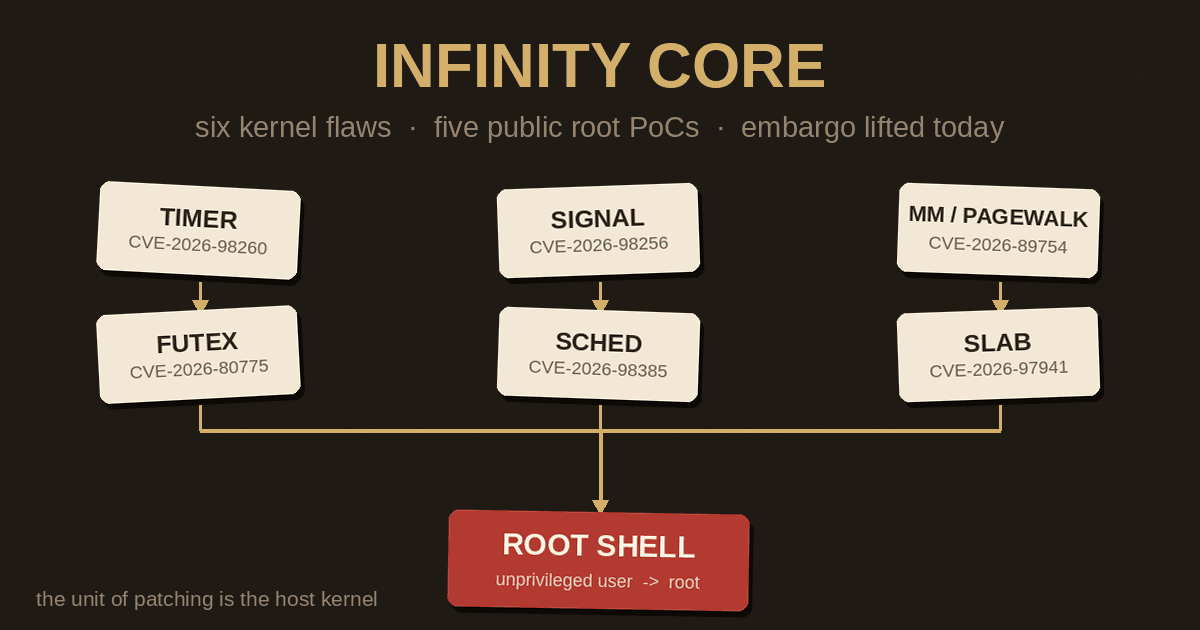

The Infinity Core Kernel PoCs Are Public. Patch the Host, Not Just the Container.
Six Linux kernel vulnerabilities got full details and working privilege-escalation exploits published on October 19. Five of them turn an unprivileged local account — or code running inside a container — into a root shell on the host. The sixth just crashes the machine, which is nearly the friendliest outcome on the list.
The researcher, Hyunwoo Kim, calls the set "Infinity Core." He reported the flaws to the linux-distros list under embargo; when the embargo expired, he posted everything to oss-security with the write-up and proof-of-concept code on GitHub.
Here is the part that should change your patch planning: these bugs live in the quiet parts of the kernel — timers, signals, memory management, futex, the scheduler, the SLUB allocator. Kim notes these areas have historically seen relatively few security issues. He also deliberately excluded the noisy areas: networking, BPF, anything that needs a user namespace.
Why your usual hardening does not help
Most hardening guides tell you to shrink the attack surface by restricting user namespaces or BPF. Reasonable advice, and it does nothing here. These flaws are reachable by any local user, or any process inside a container, using ordinary system calls. One compromised container on a shared host becomes a full host takeover. If you run multi-tenant Kubernetes nodes, shared build servers, or lab machines where other people get shells, this set goes straight to the top of the patch queue.
There is also an Android angle: Kim says the timer flaw gives full root on a Samsung Galaxy S26 Ultra from a normal app sandbox. He is holding back that exploit until Samsung ships a patch — publishing only a hash of it for now — so if you manage Android fleets, watch Samsung's security bulletins.
The six, in one table
| CVE | Subsystem | What it is | Affected kernels | Fixed in |
|---|---|---|---|---|
| CVE-2026-98260 | Timers | Use-after-free when exec() fails in a multithreaded process with CPU timers (CVSS 7.8) | 5.7 and up | 6.6.158, 6.12.112, 6.18.54, 7.2.8 |
| CVE-2026-98256 | Signals | Use-after-free from a race between exec() and signal queue cleanup (CVSS 7.8) | 6.15 and up | 6.18.54, 7.2.8 |
| CVE-2026-89754 | Memory management | Out-of-bounds write in the page-table walker used by mincore() (CVSS 7.8) | 7.0, plus some 6.18/6.19 backports | 6.18.50, 7.2.4 |
| CVE-2026-80775 | Futex | Use-after-free in private futex hash setup (awaiting CVSS) | 6.17 and up | 6.18.47, 7.1.11, 7.2.1 |
| CVE-2026-98385 | Scheduler | Use-after-free in scheduler cache accounting (awaiting CVSS) | 7.2 only | 7.2.9 |
| CVE-2026-97941 | SLUB allocator | List corruption in slab handling (CVSS 7.8) | 7.2 only | 7.2.7 |
Three details worth knowing before you plan the work:
- CVE-2026-98385 only triggers when the optional scheduler-cache feature is compiled in and switched on, on machines with more than one last-level cache. Check your kernel config before scheduling emergency maintenance for that one.
- CVE-2026-97941 has a public trigger but no privilege-escalation chain yet — it panics the kernel. Patch it anyway; a crash bug with a public PoC is a denial-of-service waiting for a tenant dispute.
- There is no confirmed exploitation in the wild yet, and none of the six is in CISA's KEV catalog. That is a statement about what we know, not a reason to wait. The PoCs are public; weaponization is a matter of time, not talent.
Which distros are affected? Wrong question, useful answer
The write-ups do not ship a per-distro list, and they should not: this is a kernel-version question, not a vendor question. Kim tested the exploits on Ubuntu 26.04 (kernel 7.0.0-30-generic) and Arch Linux (7.2.4-arch1-2).
The timer flaw (CVE-2026-98260) affects kernels since 5.7 — that is effectively everything still in support: Ubuntu 22.04 and 24.04, Debian 12, RHEL 8/9/10, Fedora, Arch, Alpine, the lot. The other five need newer kernels (6.15 and up), so they mostly bite rolling releases and the newest LTS builds: Arch, recent Fedora, Ubuntu 26.04.
One honest caveat: your distro's kernel lags upstream, so the fixed versions in the table are upstream signposts. The real question is whether your vendor's kernel package carries the fix commits, and backports vary. The vendor advisories for this exact set had not landed when this was first written — the embargo had only just lifted — so uname -r plus the table above is your starting point, then check your vendor changelog for the backported fix.
The patch checklist
- Inventory. List the running kernel on every host, not just the ones you log into. Container hosts, hypervisors, and CI runners first.
uname -ris the whole tool. - Map. Compare each running kernel against the "fixed in" column for the flaws that apply to it. Anything on 5.7+ is in scope for the timer flaw; anything on 6.15+ picks up the rest.
- Patch and reboot. Take your distro's normal kernel update, then restart the machine. The running kernel stays vulnerable until the reboot happens — livepatch buys you time on some distros, not a pass.
- Prioritize by blast radius. Multi-tenant hosts, Kubernetes and container nodes, shared build servers, anything where untrusted users get local execution. Those go first, tonight if you can.
- Verify. After the reboot,
uname -ragain, and spot-check that the vendor changelog references the CVE or the fix commit. Trust the package metadata, not your memory of having run the update. - Android fleet. Wait for Samsung's bulletin and push it when it lands. "No exploit published" is not the same as "not exploitable."
The durable point
Container boundaries were never a security boundary — this is just the freshest evidence of it. Every few months a set like this reminds us that the unit of patching on a container host is the host kernel, and the unit of exposure is every workload on the node. Boring reliability wins again: inventory, patch, reboot, verify. The exploits are public and the fixes are upstream. The gap between those two facts is the only thing an attacker needs.
Sources
- "Linux Kernel Vulnerabilities Get Privilege Escalation PoCs" — SecurityOnline.info, October 19, 2026
- "Six Linux kernel flaws enable LPE and container escape" — freenode.net, October 2026