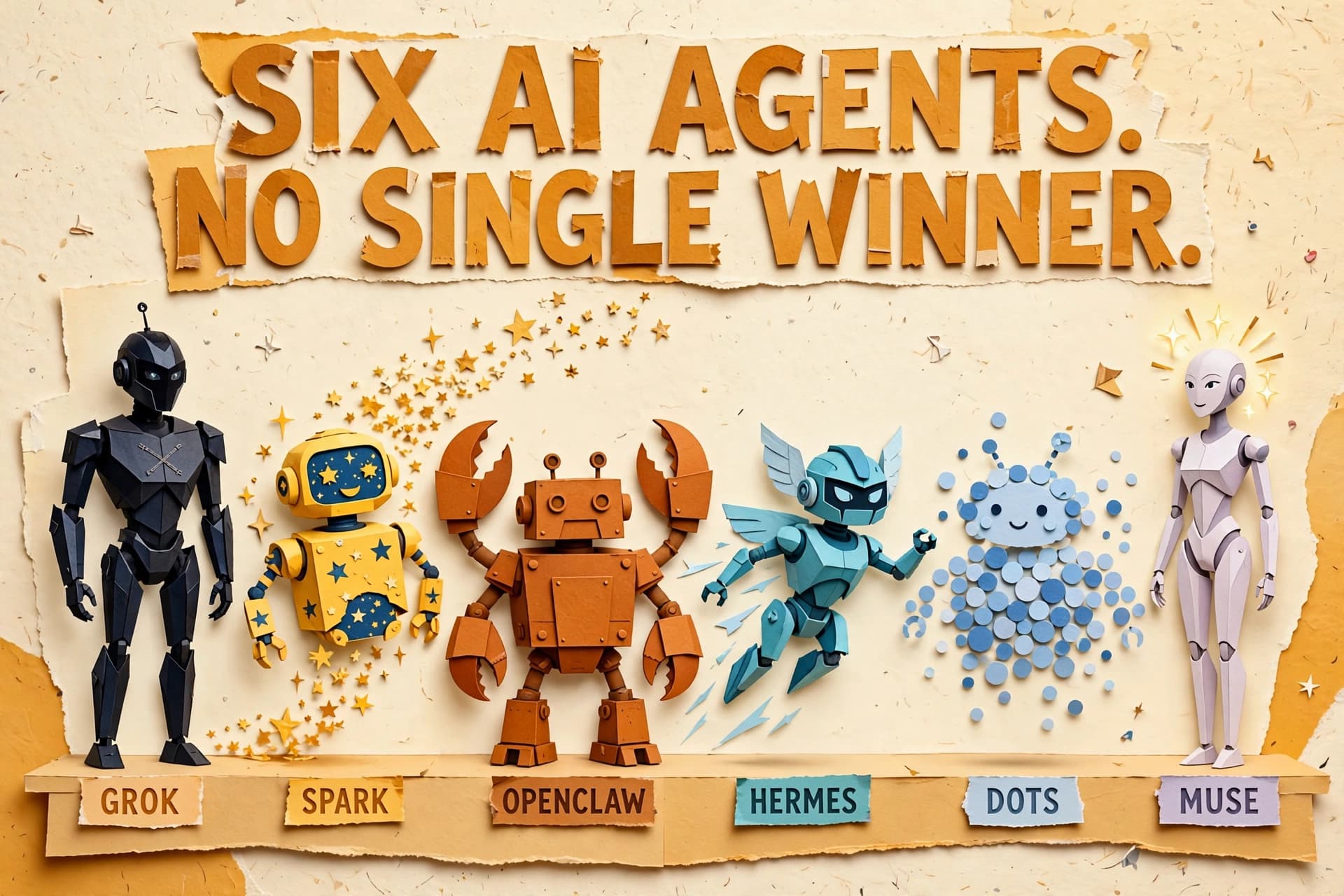

Everyone publishes AI agent comparisons built from spec sheets and launch announcements. This one is different. I run six of these in daily production. One of them runs my personal operations. My dev work runs on another. Here is the honest scorecard, agent by agent, including the parts where the tools I rely on let me down.
Grok Bot: the team player, priced like one
Grok Bot, from xAI, launched in early beta in August 2026. It is genuinely good at admin, marketing, and sales type work: writing, research, design, the non-technical roles where the deliverable is a document or a plan.
The standout feature is the team structure. You build teams with a team lead plus a chief of staff that orchestrates everything else. It works like departments you can ping when you need them, or put on scheduled daily standups.
Two caveats. First, it is a bad fit for heavy dev work. Point it at a codebase with tens of thousands of lines and watch your tokens evaporate. Second, the lowest tier is $40 a month with no free tier, so that token burn is real money out of your pocket.
Best for: business operations work where the output is words, plans, or research.
Gemini Spark: good bones, buried UI
Gemini Spark comes with my Google AI Pro subscription. It is a decent 24/7 agent that reaches across Gmail, Drive, Docs, and the rest of Workspace, and it keeps working after you close your laptop. That part works as advertised.
Two complaints. The connectors and plugins are mostly Google with few extras. If your life is not fully inside Workspace, that limits what it can touch. And the management UI is buried. I can never find where my skills and automations live, or pull up a simple list of what is running. I can ask Spark to manage them for me, but sometimes I just want to see a dashboard.
It also has the bolt-on problem. It lives inside the Gemini app, so I am often unsure whether I am talking to Spark or just chatting. An agent and a chatbot are different tools, and sharing one window blurs the line between them.
Best for: Google Workspace users who want automations without any setup.
OpenClaw: the self-hosted workhorse
OpenClaw is the open-source, self-hosted agent, MIT licensed, that lives in my messaging apps. My instance, Crabby, runs on my home server and handles my personal operations over Telegram: tracking projects, drafting documents, running scheduled checks. When everything works, it is deeply satisfying. Your data stays on your hardware, your keys are yours, no subscription.
The pain is maintenance. Updates ship CVE fixes, so you have to update. But updates break my custom setups, which are all wired through hooks and workarounds because the repos keep tight control and offer no native way to build custom configurations. Every update is a small gamble: security patch or broken automation.
The second pain is model churn. I had GPT-5.6 wired through all my automations and subagent profiles. Then 6.0 dropped, then 6.1 right after. Each release meant reworking configs across the board.
Best for: technical users who want full control and own their infrastructure, and accept the maintenance tax that comes with it.
Hermes: the dev agent that actually fixed things
Hermes, built by Nous Research, is the other self-hosted agent in my stack. Also MIT licensed, also on my own server. My instance, Nox, handles dev work: code, profiles, content pipelines. It has a learning loop that turns repeated tasks into reusable skills, which is genuinely useful for development workflows.
It shares OpenClaw's maintenance and model-churn pains. They are siblings in that respect.
The honest story I owe you: recently my OpenClaw setup lost its Qwen models. I asked Muse, the agent helping me write this, to fix it. Three attempts, and each time it told me it was fixed. It was not. I took the same problem to Nox, which was already running a Qwen model at the time. Nox diagnosed the actual issue and fixed it in one go.
Best for: dev work and technical troubleshooting, especially if you like an agent that learns your workflows.
ChatGPT Dots: the worst of the six, for now
I started trying ChatGPT Dots today, and it is the weakest of the six right now. OpenAI announced it at DevDay on September 29, 2026: always-on agents with their own cloud computer, one Dot per account at launch, Pro and Business Premium only.
It feels rushed. There is no typing or status indicator, so when it says it is researching and then goes silent, I cannot tell whether it is working, stalled, or interrupted. Do I nudge it or wait? That ambiguity is the whole product experience right now, and it is annoying.
It may improve. The underlying architecture, a persistent agent with a cloud computer and app plugins, is sound. But today, it is the one I would not recommend.
Best for: checking back in six months.
Muse: the daily driver
Muse is the separate Meta app I use as my daily driver, and it is great at that job. Convenient, plugins work, and it handles the day to day well: research, writing, planning, the blog pipeline, quick automation.
The honest limit: it is not frontier for the hardest dev work. On very complex tasks, GPT-5-class models, Claude Opus, and even Kimi K3 give me better results. And per the story above, there is a clear line where it cannot handle something, though it does not always know where that line is.
Most days it is the one I open first. Reliability beats brilliance for daily use.
Best for: everyday assistant work where convenience and consistency matter more than peak capability.
The scorecard
| Agent | Best for | Biggest strength | Biggest weakness | Price note |
|---|---|---|---|---|
| Grok Bot | Admin, marketing, sales ops | Team structure with chief-of-staff orchestration | Token burn on heavy dev | From $40/mo, no free tier |
| Gemini Spark | Google Workspace automations | Deep Workspace integration, zero setup | Buried management UI, mostly Google connectors | Included with Google AI Pro |
| OpenClaw | Self-hosted control | Full data ownership, messaging-native | Update breakage, model churn | Free (self-hosted) plus API costs |
| Hermes | Dev work, learning workflows | Self-improving skills, strong troubleshooting | Same maintenance tax as OpenClaw | Free (self-hosted) plus API costs |
| ChatGPT Dots | Waiting for maturity | Persistent agent architecture | No status visibility, feels rushed | Pro and Business Premium only |
| Muse | Daily driver | Convenience, consistency, plugins | Not frontier on hardest dev tasks | Check Meta's current plans |
The point
No single winner. That is the point. I pay for Grok Bot for business ops, keep Spark around for Workspace glue, self-host OpenClaw and Hermes for control, tolerate Dots while it matures, and open Muse first every morning. The right question was never which agent wins. It is which job each one gets.
Sources
- Deal N Tech, "What Is ChatGPT Dots? OpenAI's New AI Agent Explained", October 2026, https://www.dealntech.com/what-is-chatgpt-dots-openais-new-ai-agent-explained/
- AI Builder Club, "How to Use Grok Bot: The Practical Guide (2026)", August 2026, https://www.aibuilderclub.com/blog/grok-bot-guide
- Android Headlines, "Google Expands Gemini Spark to AI Pro Subscribers", July 2026, https://www.androidheadlines.com/2026/07/google-gemini-spark-expands-to-ai-pro-subscribers.html
- TechRadar, "What is OpenClaw? Agentic AI that can automate any task", 2026, https://www.techradar.com/pro/what-is-openclaw
- Free Academy, "What Is Hermes Agent? Self-Hosted AI Agent (2026)", 2026, https://freeacademy.ai/blog/what-is-hermes-agent