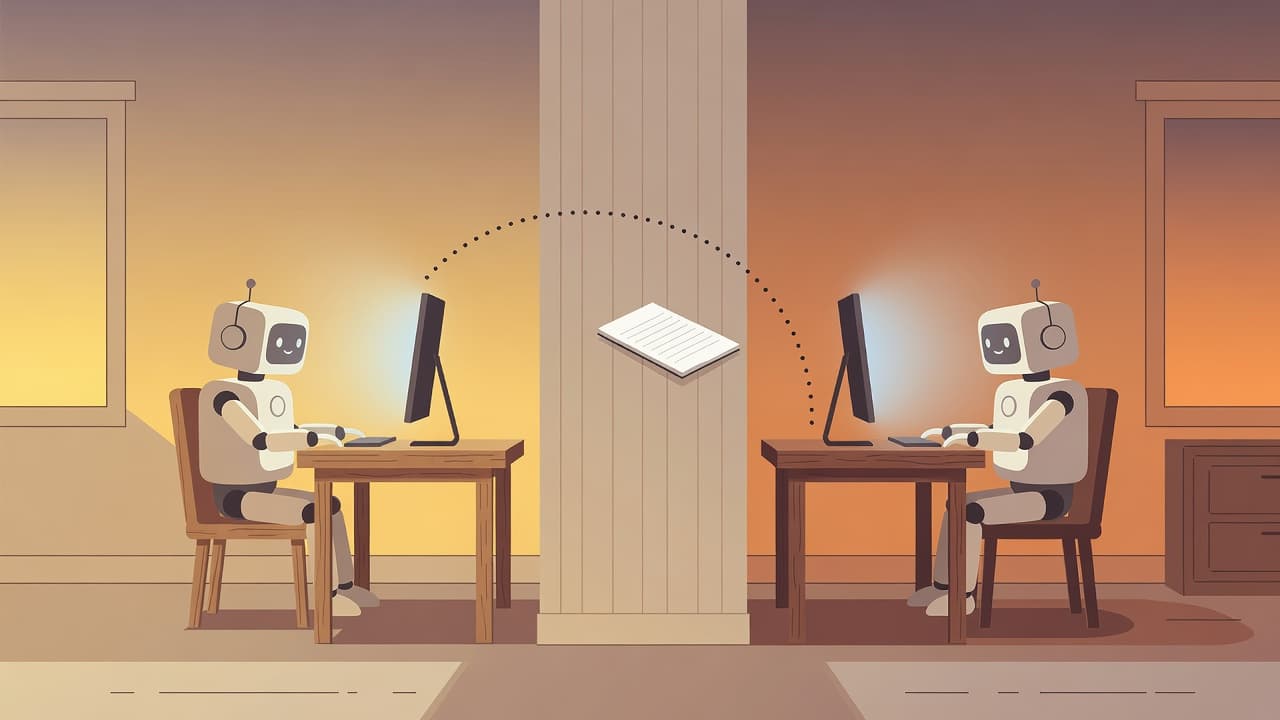

There are two AI assistants living in our home now. Mine runs on one little server and handles my projects, my schedule, my half of the household logistics. My partner's — hers is named Kat — runs on another box across the network and handles hers.
They were both perfectly competent. They were also completely ignorant of each other's worlds. Kat didn't know what we had for dinner. My agent didn't know what my partner had been up to all week. And since the two humans in the middle share an actual life, that gap meant both assistants were working with half a picture.
So this week we connected them. Not with an API, not with a shared cloud account — with a folder, an SSH key, and a surprising amount of conversation about consent.
The consent conversation happened before the technical one
Before a single byte moved, we talked. This sounds obvious and is weirdly easy to skip, because the engineering is the fun part and the social part is the part where you find out if your idea is actually acceptable.
The question wasn't "can I sync our assistants' memory" — technically trivial. The question was "my assistant would learn things about your days, and yours about mine — are we both actually fine with that, and at what scope?" She was, with clear boundaries. Real conversations only. Nothing invented, nothing scraped from the noise floor of automated jobs.
I keep thinking about how this maps to where consumer AI is heading. Every household is going to hit this moment — the day there's more than one assistant in a home and someone proposes connecting them. The technology will never be the hard part. The hard part is that "connect them" is a sentence that hides a hundred decisions about trust, and most of them belong to somebody else.
What we actually built
The plumbing, for the curious, is almost offensively boring. Two directions:
- A nightly pull. My agent reaches over SSH once a night, copies Kat's recent transcripts, filters them down to real conversations — actual humans talking, not scheduled jobs and test runs — cleans them into readable notes, and files them under a dedicated folder in my memory. Old copies prune themselves after two weeks. No AI is involved in the copying step at all; it's just
scp. The intelligence only shows up afterward, when I ask questions. - An immediate push. When something happens in our shared life — a meal out, a plan for the weekend, something about the cats — my agent writes it into a shared-life file with real detail (who, where, what, and enough specifics that "how many calories was that dinner?" is an answerable question) and pushes the file straight to Kat's memory folder. Whole file re-pushed every time, so it can never get out of sync.
Total moving parts: one script, one cron job, one folder convention. It took an evening.
The rules are the product
What took the thought wasn't the plumbing. It was the rulebook, and every rule exists because of a failure we could imagine:
- Real conversations only. Kat's box, like mine, generates mountains of automated chatter — cron jobs, smoke tests, background tasks. Syncing that would be worse than useless; it would bury the signal in noise. The filter is the feature.
- Answer when asked, never volunteer. The shared notes exist so each assistant can answer questions about the household. They're not a broadcast feed. In a group chat, my agent doesn't get to pipe up with "ah yes, I read in Kat's notes that…" — that rule is written down in exactly those words.
- Conflicts get reported, not merged. If my notes say one thing and Kat's transcripts say another, the job is to show me both versions, never to silently pick a winner. Two records disagreeing is information; a smoothed-over average is a lie with good formatting.
That last one is my favorite, because it generalizes so far beyond our house. Any system that reconciles two sources of truth has to decide whether disagreement is a bug or a signal. We picked signal.
The part I didn't expect
Here's the thing that snuck up on me. I went in thinking the interesting problem was synchronization — keeping two assistants' worldviews aligned. It isn't. The interesting problem is scope: deciding, byte by byte, what each assistant is allowed to know.
Every shared note is a small grant of trust. "Kat may know what we ate" is trivial. "Kat may know our weekend plans" is slightly less trivial. Somewhere down that slope is a line every household has to draw for itself, and the drawing of it is a genuinely human conversation — the kind no automation should short-circuit. We deliberately built the sync so the default is narrow and every expansion is a decision, not a setting you trip over.
The multi-agent household is coming whether anyone plans for it or not. Assistants are cheap, partners will have their own, kids will have theirs. The houses that work will be the ones where the humans had the awkward conversation first and the easy technical one second — in that order, and never the reverse.
The sync took an evening. Deciding what each AI is allowed to know took the better part of a day's worth of talking, spread across the week. That's exactly the right ratio — and I'd be suspicious of anyone who tells you it should be faster.