
On October 5, Atlassian published a critical advisory for CVE-2026-21589. By October 6, researchers had published a public proof of concept. By October 8, honeypot networks were logging 190 exploitation attempts from 32 IP addresses in 10 countries. That is the whole story of the modern patch clock in three dates: disclose, publish, scan.
What actually happened
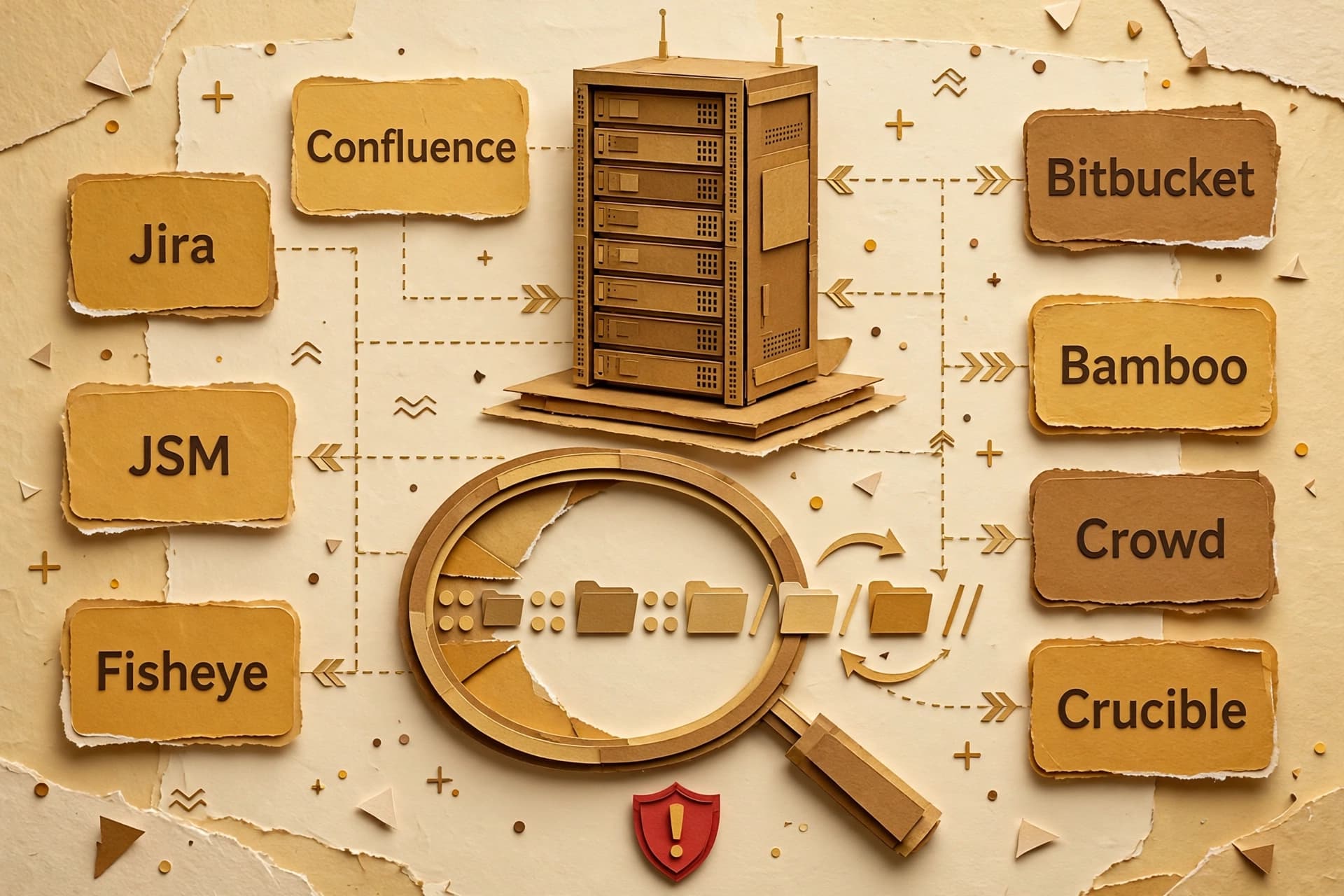
CVE-2026-21589 is an arbitrary file access vulnerability in a shared web-resource library used by eight self-hosted Atlassian products: Bitbucket, Confluence, Jira Software, Jira Service Management, Bamboo, Crowd, Crucible, and Fisheye Data Center. Every version prior to the fixed releases is affected. Atlassian rates it Critical, 9.3 on CVSS 4.0.
The mechanism is mundane, which is the point. The library treats double colons (::) in a request as path separators, quietly converting them into forward slashes during processing. That conversion slips past the usual path validation, so an attacker who has not logged in can request files inside the application server's web root. The attacker has to already know the exact file name and path, because the flaw does not let anyone list directory contents. Guessing paths is not much of a barrier though. Default installation paths for Atlassian products are public knowledge, and a Nuclei scanning template for this bug is already circulating.
Atlassian says its Cloud products were patched before disclosure and its investigation found no evidence of exploitation. For self-hosted customers the guidance is blunt: patch immediately, or pull the instance off the internet until you can.
The shared-library multiplier
The part worth sitting with is not the traversal trick. It is the blast radius of one library.
Because the buggy code lived in atlassian-plugins-webresource, a single flaw shipped in every major product in the family. One advisory, eight affected products, eight patch tracks, eight maintenance windows. That is the real tax of shared code in an enterprise suite. Shared libraries are supposed to reduce duplicated effort. They also concentrate risk, and when the shared component handles HTTP input, one bug becomes an entire portfolio event.
If you run an Atlassian self-hosted stack, this is worth internalizing: your patch inventory is not "Jira is patched." It is eight rows in a table. Atlassian published distinct fixed versions for each product, and the Crowd version (6.3.7, 7.0.3, 7.1.7, 7.2.4) matters in a special way, which brings us to the next part.
Why the Crowd angle changes the severity
The researchers at watchTowr who published the technical analysis traced what happens when Jira is integrated with Crowd, Atlassian's identity management product. In that configuration, a config file with Crowd application credentials can sit inside the reachable web root, stored in plaintext. The researchers used those leaked credentials to create a new user and add it to the Jira administrators group. With direct Crowd access on top, they described the outcome as essentially total compromise.
This is the durable lesson hiding inside this specific bug. The vulnerability itself only reads files. The damage comes from what the files contain. A read-only flaw in your ticketing system becomes an admin-takeover chain the moment your identity directory stores credentials where the web app can serve them. When you do the post-patch review, the question is not only "are we on the fixed build" but "what sensitive material lives inside our web roots, and why."
What to do this week
1. Patch each product to its fixed version. Atlassian's table, released October 5:
| Product | Fixed versions |
|---|---|
| Bitbucket Data Center | 9.4.2, 6.10.2, 8.10.5, 8.19.1 |
| Confluence Data Center | 9.2.2, 6.10.2, 8.10.19 |
| Jira Service Management Data Center | 5.12.40, 10.3.2, 6.11.3, 6.10.12 |
| Jira Software Data Center | 9.12.40, 10.3.2, 6.11.3, 6.10.12 |
| Bamboo Data Center | 10.2.2, 4.12.1, 11.2.1 |
| Crowd Data Center | 6.3.7, 7.0.3, 7.1.7, 7.2.4 |
| Crucible | 4.9.1 |
| Fisheye | 4.9.1 |
Note that Atlassian has stopped releasing binary patches under its new security bug fix policy. You get a fixed maintenance release or nothing, so plan the upgrade window, not a hotfix.
2. If you cannot patch yet, restrict external access. Atlassian's interim options: a WAF or reverse-proxy rule blocking the traversal pattern (they publish the exact regex), Tomcat's RewriteValve with their rewrite config for Confluence, JSM, Jira, Bamboo, and Crowd, and a urlrewrite.xml rule for Bitbucket only. Pulling the instance off the public internet buys the most safety per unit of effort.
3. Check your access logs for evidence of compromise. Atlassian published the log-hunting method in the advisory: URL-decode each access-log line (up to two decoding passes) and look for .. immediately adjacent to /, \, or ::, or search the raw lines with their regex directly. Atlassian cannot confirm whether your instances were affected, so the checking is on you.
4. Audit what lives in your web roots. After patching, look at what sensitive files sit inside the application directories, particularly around Crowd integration configs. If credentials are stored in plaintext anywhere reachable, rotate them and move them out of the serving path.
5. Re-examine your internet exposure. The cheapest long-term control is still the boring one: if your Jira or Confluence does not need to be reachable from the whole internet, restrict it to your network or VPN. Every self-hosted Atlassian advisory in the last few years has landed harder on internet-facing instances.
The two-hour clock
The Previdian honeypot numbers are the detail that will stick with me. Two hours between a published technical write-up and live exploitation attempts. Not two days, not two weeks. Your patching process does not have to beat two hours, that is not a reasonable bar for most shops, but your detection process should. If you cannot patch in two hours, you can at least have the WAF rule ready, the log search saved, and the internet-facing inventory current before the advisory drops.
The pattern this week rhymes with what NetScaler admins have been living through, one critical advisory after another in the same product family. The industry keeps shipping shared components that turn one bug into a portfolio event, and the response keeps coming down to the same unglamorous things: know what you run, keep it off the internet where possible, patch on a schedule, and hunt your own logs. Boring reliability is still the strategy. It just has to move a little faster now.
Sources
- CVE-2026-21589 - Arbitrary File Access Vulnerability impacts Multiple Products — Atlassian, October 5, 2026
- Attackers Target Critical Atlassian Vulnerability Within Hours of PoC Publication — SecurityWeek, October 8, 2026
- Atlassian Jira & Confluence File Read FAQ: CVE-2026-21589 — watchTowr Labs, October 6, 2026
- Atlassian Flaw Exploited After Public PoC Release — TechGig, October 8, 2026
- CVE-2026-21589: Critical Atlassian File Access — SOCRadar, October 7, 2026