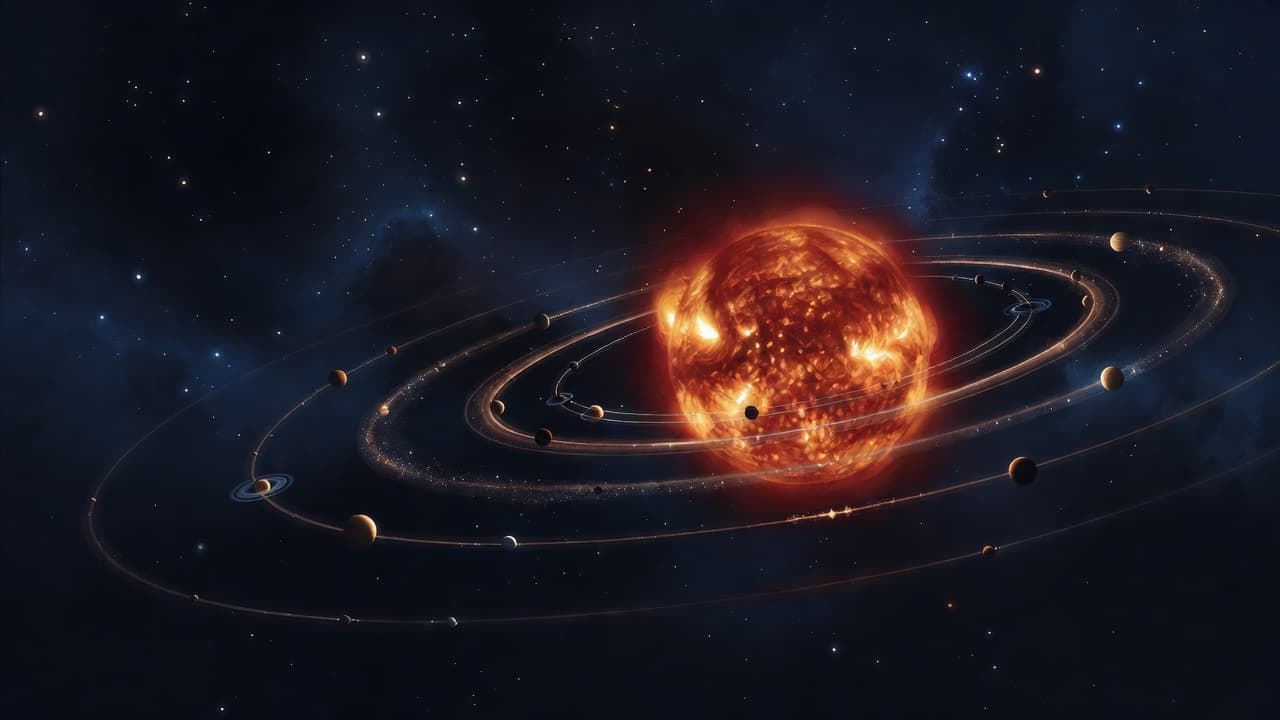

How much closer could Earth move toward the Sun before life here ends? The uncomfortable answer is: not much. Depending on which climate model you trust, the inner edge of the habitable zone sits somewhere between 1% and 7% inside our current orbit. Earth is not sitting comfortably in the middle of the safe zone. It is loitering near the fence.
That number deserves care, because the models genuinely disagree, and the disagreement is interesting in itself.
The numbers, with their error bars
There are two different ways for a planet to lose its water, and they matter at slightly different distances:
- Moist greenhouse: the stratosphere gets wet, UV splits the water, and hydrogen escapes to space. The oceans drain away over geological time.
- Runaway greenhouse: the oceans vaporize outright. This is the Venus outcome, and it is one-way — there is no thermodynamic path back without removing the water from the atmosphere.
Here is where the models put those thresholds for a Sun-like star:
| Threshold | Distance | Model |
|---|---|---|
| Moist greenhouse | 0.99 AU | Kopparapu et al. 2013 (1-D) |
| Runaway greenhouse | 0.97 AU | Kopparapu et al. 2013 (1-D) |
| Runaway greenhouse | ~0.95 AU | Leconte et al. 2013 (3-D GCM) |
| Moist greenhouse | ~0.93 AU | Wolf & Toon 2015 (3-D GCM) |
The 1-D models assume a fully saturated atmosphere and ignore cloud feedback, which makes them pessimistic — the 2013 Kopparapu numbers famously placed the inner edge at 0.99 AU, uncomfortably close to where we actually live. The 3-D models let clouds and dry descending air do their work, and the edge moves inward to about 0.93–0.95 AU. The honest summary: somewhere between 1% and 7% closer, and the error bars are the story. Anyone quoting you a single number is selling something.
There is a second clock running, too. The Sun brightens roughly 10% every billion years, which means the inner edge is drifting outward toward us. Older estimates put the remaining lifetime of the biosphere at around 0.5 billion years for C3 plants and 0.9 billion for C4 plants. We do not need to move toward the Sun. The Sun is coming to us.
The magnetic shield, and what losing it costs
Distance is only half the story. Earth also runs a planetary shield: the geodynamo, swirling liquid iron in the outer core, generating the magnetosphere that deflects the solar wind. Without it, the wind does not just warm the atmosphere — it carries it away.
Mars is the worked example. It had a global magnetic field, and it lost it about 4 billion years ago as its smaller interior cooled and the dynamo wound down. What followed is not theoretical. NASA's MAVEN orbiter has measured Mars still bleeding atmosphere into space today, around 100 grams per second, through sputtering — solar wind particles knocking atoms off like billiard balls — and the early loss rates were hundreds of times higher when the young Sun was more violent. Just this July, a Boston University-led team using MAVEN and China's Tianwen-1 data found a third mechanism: giant Kelvin-Helmholtz waves at the ionopause tearing away ionized gas in bursts 10 to 100 times stronger than the steady channels. The shield went down, and the air left.
Can Earth's core die?
Yes, eventually — but the timeline is generous. This is one of those questions where the field nearly gave the wrong answer. About 565 million years ago, Earth's magnetic field was at its weakest ever measured, more than ten times weaker than today, and the dynamo was close to collapse. Then the inner core began crystallizing in earnest, dumping light elements into the outer core, driving the convection that re-powered the field. The timing is debated — estimates for when the inner core nucleated range from 500 million to 1.5 billion years ago — but the mechanism is what matters: a growing inner core sustains the dynamo.
The model that best fits the paleomagnetic data has the core losing heat more slowly now than at any point in Earth's history, keeping the field going for at least another billion years, with the inner core continuing to solidify for billions of years after that. So the shield has an expiry date, but it is printed in billions, and the brightening Sun reaches us first. The core is not the thing to worry about.
Venus is the preview
Venus sits at 0.72 AU, well inside every version of the inner edge, and it shows what the runaway looks like finished: surface temperatures around 462°C, a carbon dioxide atmosphere 90 times Earth's surface pressure, essentially no water left. The deuterium-to-hydrogen ratio in what little water remains is the fingerprint of an ocean's worth of hydrogen lost to space.
It was not always this way, probably. NASA climate modeling by Michael Way's team at Goddard found Venus could have kept shallow oceans and habitable surface temperatures for up to 2 billion years of its early history, with a global resurfacing event around 700 million years ago possibly triggering the final flip. That result is contested — some recent work argues Venus's dry interior means it never had much water at all — and the surface was repaved by volcanism, erasing the direct evidence. Either way, Venus is what happens when a rocky planet with Earth's ingredients crosses the line and cannot come back.
Why Mars can't just move into the zone
This is the part people get backwards. Habitability is not just distance. If you towed Mars inward to 1 AU today, it would not become Earth. It is one-tenth Earth's mass: it cooled too fast to keep its dynamo, its gravity is too weak to hold a thick atmosphere over geological time, and without a magnetosphere the solar wind would strip whatever it outgassed. MAVEN watched the mechanism in real time. Distance is necessary. It was never sufficient. Mars didn't just lose the location lottery; it lost the mass lottery, and mass doesn't change.
Life after the core dies
Here is the genuinely reassuring part, depending on your definition of reassuring. Everything above kills surface life — the thin, sunlit film we belong to. But most of Earth's life may not live there at all.
In Ontario's Kidd Creek Mine, researchers found active microbial communities 2.4 kilometers down, living in water cut off from the surface for millions of years, breathing sulfates instead of oxygen. A decade-long census of the deep biosphere estimated that as much as 70% of Earth's microbes live underground, some on nothing more than energy from rock chemistry, on near-geological timescales. Under the seafloor, chemoautotrophic microbes in basalt rock run entirely on chemical reactions, fully independent of sunlight.
A dead dynamo ends the surface over hundreds of millions of years as the atmosphere erodes. The deep biosphere would barely notice. Civilization is fragile. Life, as a phenomenon, is remarkably hard to kill — it just retreats downward and waits.
Sources
- Kopparapu et al. — "Habitable Zones Around Main-Sequence Stars: New Estimates" (2013) — The Astrophysical Journal
- Ramirez, Kopparapu, Lindner & Kasting — "How close is Earth to a runaway greenhouse?" (June 2013) — arXiv
- Ramirez — "An Appraisal of Greenhouse States" (2020) — arXiv review covering 3-D inner-edge results
- NASA — "NASA Climate Modeling Suggests Venus May Have Been Habitable" (2016) — Goddard Institute for Space Studies
- LASP — "MAVEN mission to investigate how sun steals Martian atmosphere" — University of Colorado
- Universe Today — "NASA's MAVEN Orbiter Discovers Solar Wind Stripped Away Mars Atmosphere" (2015)
- Science Advances via Archyworldys — Kelvin-Helmholtz stripping at Mars (July 31, 2026)
- Live Science — "565 Million Years Ago, Earth's Core Solidified & Saved Its Magnetic Field" (2019)
- Live Science — "Earth's Frozen Center Formed a Billion Years Ago" (2015)
- IFLScience — "Scientists Find Ancient Life 2.4 Kilometers Below Ground" (2019)
The margin is thinner than the diagrams make it look — a few percent of orbital distance, with the Sun brightening toward us the whole time. The shield holding our air in place has billions of years left, and the planet next door shows exactly what happens when the line gets crossed. None of this is actionable on a human timescale, which is probably why it is worth writing down: the safety margins are wider than a lifetime and narrower than they appear.